IMPORTANT NOTICE ABOUT COMMENTS

COMMENTS HAVE BEEN DISABLED

Because of spam, I personally moderate all comments left on my blog. However, because of health issues, I will not be able to do so in the future.

If you have a personal question about LI or any related topic you can send me an email at stevecarper@cs.com. I will try to respond.

Otherwise, this blog is now a legacy site, meaning that I am not updating it any longer. The basic information about LI is still sound. However, product information and weblinks may be out of date.

In addition, my old website, Planet Lactose, has been taken down because of the age of the information. Unfortunately, that means links to the site on this blog will no longer work.

For quick offline reference, you can purchase Planet Lactose: The Best of the Blog as an ebook on Amazon.com or BarnesandNoble.com. Almost 100,000 words on LI, allergies, milk products, milk-free products, and the genetics of intolerance, along with large helpings of the weirdness that is the Net.

Showing posts with label diet. Show all posts

Saturday, August 07, 2010

Paleolithic Restaurant Discovered in Arizona

Wow, remember The Stone Age Diet, also known as the Paleolithic Diet or the Cave Man Diet? The idea behind the diet is that humanity evolved to eat fruits, vegetables, and lean meats rather than dairy, grains, sugar, and processed foods. Therefore, the best diet for us today is a copy of that limited menu.

Guessing what humanity ate over tens or hundreds of thousands of years in varying climates and settings is a bit harder than knowing exactly what was eaten, so the various claims for the diets wobble all over the place. I have more references in the link given above.

I hadn't heard of this fad for several years. (And it is a fad diet. There is no necessary reason or scientific backing for it, other than the common sense claims that are sometimes made.) But an Arizona chef has opened a Paleolithic Diet restaurant in trendy Scottsdale.

An article by Carey Sweet of the Arizona Republic splashes a few details.

Some chefs try to predict future trends for their cooking inspiration. Calistro California Bistro chef-owner Devin Walsh is looking back. By about 2.5 million years....

It celebrates foods people ate prior to agriculture and animal husbandry (such as wild game or grass-fed meat, wild-caught fish, shellfish, eggs, tree-nut oils, vegetables, roots, fruit, berries and mushrooms). Not allowed are Neolithic Era foods that evolved from our manipulation (grains, sugar, dairy, beans, and processed foods).

You wouldn't be grazing on mostly dozens of species of plant material with some scavenged raw meat, though. Perish forbid.
For appetizers, Walsh offers chicken or lamb meatballs blended with prosciutto and tomato jam on an almond-meal tortilla. Entrees include salmon over fresh crab and organic-vegetable hash with citrus beets and a dollop of tarragon-mustard or chimichurri pork roast atop sweet-potato mash.

Bees are found everywhere, so "Desserts are sweetened with honey, including poached fruit with house-made granola."

Wait, granola? Isn't granola made with grains?

Never mind. Our Paleo ancestors would find every bit of food in that description odd. And would love, love, love to have the luxury of eating grains, sugar, dairy, beans, and processed foods. Authenticity is a luxury given to the decadent. Enjoy.

Bookmark and Share

Monday, May 03, 2010

Dairy and the New Food Pyramid

In yesterday's post I heaped scorn upon Dr. Mark Hyman, a doctor whose trip into alternative medicine has taken what I consider to be deadly detours.

However, he cited Dr. Walter C. Willett as someone against the supposed beneficial uses of dairy. Dr. Willett is as mainstream as medicine gets. He's the Chair of the Department of Nutrition and Fredrick John Stare Professor of Epidemiology and Nutrition at the Harvard School of Public Health. Moreover, he's led the most important large and long-term studies of health that pretty much anyone has done anywhere.

1. the 121,700-member Nurses' Health Study, initiated by Dr. Frank Speizer at the Channing Laboratory;

2. the Health Professionals Follow-up Study, a cohort of 52,000 men; and

3. the Nurses' Health Study II, a cohort of younger women numbering 116,000

When I kept railing at the small numbers and lack of meaning of studies on lactose intolerance found in the most exhaustive possible search of specific studies on lactose intolerance, milk, and calcium by the researchers presenting at the NIH state-of-the-science conference on Lactose Intolerance, I kept hoping they would cite some studies as major as the Nurses' Health Study. They never did.

The conclusions drawn from the Nurses' Study are opposed to all the conclusions drawn by the smaller, but more specific studies, done on dairy and calcium.

I found an article based on a Los Angeles Times article that is no longer online that summarizes Willett's understanding on the subject.
When Willett and his colleagues investigated the milk-drinking habits of 72,000 women in the Nurses' Health Study, they found that milk consumption was not associated with a lower risk of hip fracture, a measure of bone strength. In fact, women who drank milk twice a day were as likely to suffer a bone break as women who drank it once a week.

Likewise, the Health Professionals Follow-Up Study failed to find a relationship between calcium intake and bone fractures in more than 43,000 men. And a 2003 Swedish study of more than 60,000 women, which was published in the journal Bone, found no association between dietary calcium intake and fracture risk.

"We do need some calcium -- it's essential -- but the question is, how much?" says Willett, author of the 2001 book "Eat, Drink, and Be Healthy." He believes the body needs 500 to 700 milligrams of calcium daily rather than the 1,000 to 1,500 milligrams a day recommended by the dietary guidelines.

Why the difference?
Most clinical trials -- studies in which one group of people increases calcium intake and another group does not -- have shown that adding calcium to the diet increases bone density. But most clinical trials last for less than three years, says Diane Feskanich, an investigator for the Nurses' Health Study. "It could be that bone density does not continue to increase in the long run -- in fact, a study that went on for three years found that after an initial increase in bone density, it did not continue to increase in the third year."

Observational studies such as the Nurses' Health Study "are usually run over many years and in this way better suited to determine the long-term effects of high calcium intakes," Feskanich says.

Because of this, Willett was a long-time critic of the government Food Pyramid, and he wasn't afraid to say why the Pyramid was so bad.
There was not much receptivity in the 1990s, when we raised these criticisms of the food guide pyramid. It was almost an accepted religious belief that fat was bad and carbohydrates were good. Then there were lots of economic interests behind the food pyramid as well. Clearly the dairy industry is extremely well represented in the food pyramid. The beef industry is there, and it's very convenient that beef is combined along with fish and poultry and nuts and legumes. So each one of those industries can say: It's healthy to have three servings a day of our product.

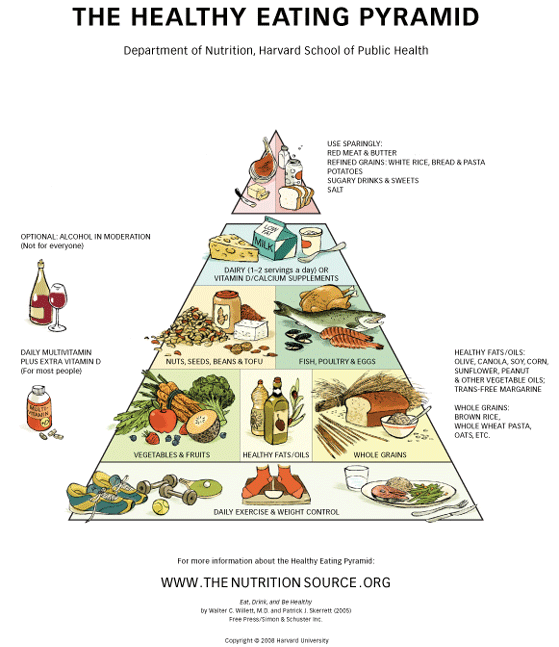
In fact, the Harvard School of Public Health drew up a complete alternate food pyramid to promote what they suggest should really be in a proper diet.


Here's the part that the Hymans of the world won't tell you. The Healthy Food Pyramid contains dairy. It has this to say.
Dairy (1 to 2 Servings Per Day) or Vitamin D/Calcium Supplements

Building bone and keeping it strong takes calcium, vitamin D, exercise, and a whole lot more. Dairy products have traditionally been Americans' main source of calcium and, through fortification, vitamin D. But most people need at least 1,000 IU of vitamin D per day, far more than the 100 IU supplied by a glass of fortified milk. (See the multivitamins section, below, for more information on vitamin D needs.) And there are other healthier ways to get calcium than from milk and cheese, which can contain a lot of saturated fat. Three glasses of whole milk, for example, contains as much saturated fat as 13 strips of cooked bacon. If you enjoy dairy foods, try to stick mainly with no-fat or low-fat products. If you don't like dairy products, taking a vitamin D and calcium supplement offers an easy and inexpensive way to meet your daily vitamin D and calcium needs.

That's not exactly in line with Willett's older pronouncements. The needs and the evidence has indeed changed over time.

And compare this:
Choose fat-free or low-fat milk, yogurt, and cheese. If you choose milk or yogurt that is not fat-free, or cheese that is not low-fat, the fat in the product counts as part of the discretionary calorie allowance.

If sweetened milk products are chosen (flavored milk, yogurt, drinkable yogurt, desserts), the added sugars also count as part of the discretionary calorie allowance.

For those who are lactose intolerant, lactose-free and lower-lactose products are available. These include hard cheeses and yogurt. Also, enzyme preparations can be added to milk to lower the lactose content. Calcium-fortified foods and beverages such as soy beverages or orange juice may provide calcium, but may not provide the other nutrients found in milk and milk products.

That sound awfully similar, doesn't it? Know where it comes from? From the new, revised government MyPyramid Food Pyramid.


Notice the difference between the two? The Harvard pyramid is incredibly complicated. The consuming public is not. In one of the posts on the conference I talked about the problem of comprehension a frightfully large percentage of the American population has with even the most basic food terms. The new Food Pyramid was drastically simplified because of this very problem. In fact, read how wonderfully easy-to-understand the new presentation is:
Six swaths of color sweep from the apex of MyPyramid to the base: orange for grains, green for vegetables, red for fruits, a teeny band of yellow for oils, blue for milk, and purple for meat and beans. Each stripe starts out as the same size, but they don't end that way at the base. The widths suggest how much food a person should choose from each group. A band of stairs running up the side of the Pyramid, with a little stick figure chugging up it, serves as a reminder of the importance of physical activity.

MyPyramid contains no text. According to the USDA, it was "designed to be simple," and details are at MyPyramid.gov.

That's taken directly off the Harvard Healthy Pyramid page.

I left off a few sentences, though.
Unless you've taken the time to become familiar with the Pyramid, though, you have no idea what it means. Relying on the Web site to provide key information—like what the color stripes stand for and what the best choices are in each food group—guarantees that the millions of Americans without access to a computer or the Internet will have trouble getting these essential facts.

The USDA also chose not to put recommended numbers of servings on the new Pyramid because these differ from individual to individual according to weight, gender, activity level and age. Instead, it offers personalized Pyramids at MyPyramid.gov.


That's a problem, although not a completely fair one. The government provides a wide variety of print materials, some targeted at Spanish-speaking audiences, mothers and mothers-to-be, and different ages. I'm sure America is awash in print explanations of the Pyramid.

The other legitimate objection is that MyPyramid is not accurate or give specifics. Notice that the Healthy Food Pyramid has a dozen parts.

That's the big issue. I face it every time I sit down at the keyboard and so does every other writer about health, diet, and nutrition. How much information to give? How much to simplify? What understanding can you assume your audience has? Will they get confused by too much detail or suffer if detail is slighted?

Harvard and the government came down on very different sides of this issue. I've given you both. Read them, download them, print out the posters. Decide for yourselves.

Bookmark and Share

Sunday, March 14, 2010

Eatright.org

While we're taking a lunch break from the series of LI Conference posts, I'm going to catch up with some of the news about nutrition and products that I've been missing the past couple of weeks.

The American Dietetic Association (ADA) is an important source of good, solid information about dietary issues. They've updated their website, which can be found at www.eatright.org/Public/.

They put out a press release that touted the new features.

1. Diet reviews» This section looks at popular diets (South Beach, the 4-Day Diet, the Flat-Belly Diet, among others) and reviews them from a medical standpoint. A member of the ADA summarizes the diet's claims and strategies, lays out its nutritional pros and cons, and offers a bottom-line critique on whether it's a sound dietetic choice.

2. Question of the day» What is the shelf life of canned vegetables? Is lactose-intolerance the same as a milk allergy? Can pizza be healthy? A new query is posed and answered every one to two days, often with a link to other resources if you're looking for even more information.

3. Find a dietitian» Enter your ZIP code and specialty needs (e.g., celiac disease, weight control), and the site will provide a list of qualified dietitians and their contact information.

4. "Weigh In" blog» Registered dietitians blog about tackling a loved one's eating habits, helping kids navigate snack time, the earthquake in Haiti and other timely topics. The comment section - often the most fun part of blog reading - is sparse at this point, but that might improve as the site attracts more readers.

5. Disease management and prevention» It can be hard to get your general practitioner to discuss diet's role in various diseases, so this section - with information on autism, cancers, kidney disease and others - is a great place to turn for answers.

Bookmark and Share

Friday, February 05, 2010

Wanted: Single Lady. Must Be Lactose Intolerant

Humans, those of us who are members of the genus Homo, have been around for well over two million years. Homo sapiens emerged a good 200,000 years ago. Yet farming, animal and plant domestication, herding, and therefore milking have existed for less than 15,000 years. The math is irrefutable. Even modern humans spent move than 90% of their existence without milk or dairy products as a part of their diet. This also has to be true for most grains, as well as the fruits and vegetables that are part of the western diet. You never hear the anti-milk crazies mention that when they say that humans are not "designed" to digest milk.

Humans are omnivores. They can eat anything. Their digestive systems are different from either carnivores or herbivores and they have the digestive enzymes to break down any food into amino acids, fatty acids, and simple sugars.

Yet there is an argument to be made that all that genetic heritage must have some effect. It's an argument similar to the ones saying that we are not "designed" to sit in chairs, sleep in beds with pillows, and drive everywhere. Not to mention that we are "designed" to squat rather than sit while eliminating waste.

So what did humans eat for that first 99+% of their Homo years? Meat, fish, vegetables, fruit, roots, and nuts. Mushrooms, eggs, seeds, and lots of insects. Anything we could scavenge, trap, or pluck. Nothing deliberately grown. Or fermented (think wine, beer, and koumiss). Or processed (like, coffee, tea, or chocolate and especially not sugar). Definitely not vegan, either, since we used every part of the animal and broke bones to drink the marrow. We certainly didn't scorn plant material, of course. Estimates are that we might have scrounged some 200 species of greens. This diet would be low in carbs (although high in fiber) and probably low in fat, since wild animals are normally extremely lean. We've bred animals to add fats since we started domesticating them.

Walter L. Voegtlin was the first to advocate eating as are ancestors did in the The Stone Age Diet, a book he had to self-publish in 1975. The notion gained academic support after medical journal articles and the book The Paleolithic Prescription: A Program of Diet & Exercise and a Design for Living, S. Boyd Eaton, Marjorie Shostak, & Melvin Konner appeared in the 1980s.

The latest advocate for living a pre-civilization lifestyle (literally so, since the rise of cities - the basis for civilization - are based on the rise of farming and herding) is John Durant, founder of Hunter-Gatherer.com. He's single, ladies, and he's looking for a lactose-intolerant (and possibly even gluten-intolerant) wife. He said so in so many words on Stephen Colbert. Here's the clip.

The Colbert ReportMon - Thurs 11:30pm / 10:30c
John Durant
www.colbertnation.com
Colbert Report Full EpisodesPolitical HumorEconomy


Bookmark and Share

Monday, August 11, 2008

Kate DeAraugo's Lactose Intolerance

I come across many "huh?" moments when searching for material for this blog. Huh" as in "what were they thinking?" "Huh?" as in "how could that possibly happen?" "Huh?" as is "how could anyone be that stupid?"

And sometimes just "Huh?" as in "what in the world is going on here?"

I just had that last feeling when I read this article from the Australian site of SkyNews Online. [Article taken down by August 12. Intestesting.]

Former Australian Idol, Kate DeAraugo, has quit her endorsement deal with weight loss company Jenny Craig.

It follows reports health problems were hampering the singer's efforts to shed the pounds.

Since being named idol winner back in 2005, DeAraugo has had a public battle with her weight, hoping to beat the battle once and for all when she became Jenny Craig's latest celebrity fat fighter at the beginning of the year.

However the split has been confirmed by the weight loss company after it was found out the singer was not losing weight due to a lactose and glucose intolerance.

She couldn't lose weight because of lactose intolerance? Or because of gluten intolerance? Those statements don't belong together. If you can't eat dairy or wheat without symptoms, you find substitutes. What you eat and how you exercise have bearing on whether or not you gain or lose weight (or stay the same). The mere fact of being lactose intolerant is entirely irrelevant.

She has had health problems that could very well be linked to efforts to lose weight. An October 2005 blog post noted that the then 19-year-old had already lost 30 kilos (66 pounds) in 2005 and had two fainting spells before winning the competition. I'm not walking out on a very thin rope to guess that the weight loss and the fainting were related or that her desperate slimming was done to acknowledge the planetary culture of thinness in beauty. She's gone up and down in weight since, and became the Jenny Craig spokesmodel in January.

She never should have been allowed anywhere near that position with her history. I'm stunned into another "huh?' moment by the thought that Jenny Craig didn't have doctors check her out before signing the deal. That's a "what were they thinking?" moment?

No matter what the outcome might be - I somehow doubt the story ends here - the real problems for DeAraugo concern her yo-yo dieting and what that might be doing to her long-term health. Yes, she might be both lactose and gluten intolerant. That's not a big deal. (Not will it cause you to faint.) Now that she knows she can eat healthier foods that won't cause her any symptoms. If she can get away from the deadly spotlight that shines on the outline of her body she has a great rest of her life ahead of her. If not, then food intolerances are the least of her problems.

UPDATE: The Australian News.com.au published a follow-up to the earlier story.
I went to the doctor and my body doesn't digest certain foods well, so I decided it was bad for them and I didn't want to do bad by them.

However DeAraugo seemed to be confused by her dietary dilemma when quizzed by an equally uninformed Kyle Sandilands.

After first stating she was unable to digest gluten - a condition known as coeliacs disease - DeAraugo then said she was lactose intolerant after being prompted by Sandilands.

Lactose intolerance refers to the inability to process dairy, not gluten.

All right! Is everything clear now?

All this latest bit of nonsense says is that we haven't heard any of the real truth about this story. But we have heard lactose intolerance once again used as a convenient scapegoat.

Ugly, ugly, ugly.

Bookmark and Share

Sunday, July 27, 2008

Dairy-Free Fertility?

It's no secret that the average age of motherhood has been rising for decades, since the baby boom mothers of the 1950s. With women waiting longer to get married in the first place, and then postponing motherhood to get a good start on their careers, the incidence of women worrying about their impending loss of fertility has created a boom of its own - books preying on their hopes and fears.

And that brings up to Sarah Dobyns, author of The Fertility Diet: What to Eat to Maximise Your Chances of Having a Baby and to Enhance Libido at Any Age. That shouldn't be confused with The Fertility Diet, a wholly different book by by Jorge Chavarro, Walter C. Willett, and Patrick J. Skerrett. Or, for that matter, with The Infertility Diet: Get Pregnant and Prevent Miscarriage, by Fern Reiss. Or about fifty other books with variations on these titles.

Dobyns' advice must be followed by both halves of the couple, and is mostly a long list of what not to eat, with oddly specific timing on when not to eat it, according to an article by Fiona Macrae on the Daily Mail Online.

The most comprehensive guide of its kind, it advises cutting out smoking, artificial sweeteners, alcohol, caffeine and soya in the first month. Peas and rhubarb are also banned, following studies linking them to infertility.

By month two, couples should have given up all meat and cut out sugar and dairy products.

Come the third month, consumption of eggs and fruit juices should be reduced.

What do doctors say about this? Pretty much exactly what you would expect.
Professor Bill Ledger, a fertility expert from Sheffield University, said lifestyle did not have a major effect on fertility and he was unaware of any evidence that vegans go through menopause at a different time to other women.

He added: 'We tend to create a lot of guilt in people these days.

'The worry is that some gullible young woman will read this book and start living that life and miss out on a lot of fun and normality.'

The authors of that other Fertility Diet book, who are doctors, by the way, offer the following as a way to increase your chances of fertility:
Having a glass of whole milk or other full-fat dairy product every day (a small bowl of ice cream every now and then counts, too!)

But it worked for Dobyns, right? She's doing this from experience, isn't she?

Hah.
The 43-year-old former barrister ... is engaged and plans to start trying for a family soon

If you want children, I wish you luck. But don't think you're going to get pregnant by giving up all dairy. Or by having your husband give up dairy with you. You'll have better luck with the stork and the cabbage patch.

Bookmark and Share

Saturday, July 12, 2008

Detox Your Brain, Not Your Diet

Detox diets are the latest food fad quackery, mystic nonsense that play on consumers' fears and ignorance. Oprah is partly to blame, as she so often is. She embarked on a much-publicized 21-day vegan detox diet. Then she ate her way through Italy, according to the Los Angeles Times.

Now MSNBC.com has given ultra-huckster Mark Hyman, author of the UltraMetabolism series of cookbooks, space to spread his detox mishmash.

The bottom line is that quality is MUCH more important than quantity. Eating only whole, fresh, real food completely eliminates the need for calorie counting, or measuring fat grams or counting carbs.

This works for one simple reason — you eat not only calories but also information. Eat the wrong information and you give your genes instructions to make you fat. Eat the right information and you give your genes instructions to lose weight. This is based on an exciting new understanding of how food talks to your genes called nutrigenomics.

And it doesn’t work slowly over years, but literally in minutes.

Most doctors who aren't trying to huckster their books think that detox diets are phony. They say that the body simply doesn't work like this.

The BBC did a non-scientific test of a detox diet:
We took ten party animals to a country cottage retreat for ten days to see if a detox diet could recharge their internal batteries. The group was split into two and half the girls were put on a balanced diet, including red meat, alcohol, coffee and tea, pasta, bread, chocolate and crisps (in moderation), with the remainder following a strict vice-free diet.

Can a short, sharp shock really change the levels of toxicity in your body in just a week?

After testing the kidney and liver functions and measuring the antioxidant and aluminium levels in their blood we found there were no differences between the groups.

Of course, such a stunt test has no scientific value. But it is just as sound as the non-science that's used by the detox gurus to plug their books.

One thing most of the detox diets have in common is the magnification of dairy allergy as a problem. Very few adults have dairy allergies without knowing it, but claiming that it's a common problem that the detox diet can fix will cause the unaware to assume that any improvement they feel is the result of the elimination of that allergy.

Now it's certainly true that whole fresh food is usually good for you. And it's certainly true that most Americans eat too much of the wrong foods, dine at restaurants that pile too much fat and sugar onto plates, and snack unhealthily. You don't have to give up all food with a label to improve your diet over this. Most people who aren't food faddists can't afford to spend multiple times the money they spend today for exclusively fresh and unprocessed food, or spend the hours needed to cook these foods immediately before they spoil. Hyman and his ilk appeal to the idiot affluent, rather than the people with the documented health problems.

Don't fall for detoxing. Don't - and I know this is heresy - listen to Oprah for food advice. (You guessed it, her pet doctor Mehmet Oz is another food faddist.) Buy good foods that you can afford. Eat less, and exercise more. Don't expect your food to talk to your genes. Let your brain do its work.

Bookmark and Share

Monday, December 24, 2007

Subsidized Food Program Recognizes Lactose Intolerance

Poor people in the U.S. eat some of the unhealthiest diets. They aren't helped by government programs that provide standardized food baskets that fail to take heed of special diet needs.

A recent announcement provides welcome news. The Women Infants and Children (WIC) program is changing its policy.

WIC provides Federal grants to States for supplemental foods, health care referrals, and nutrition education for low-income pregnant, breastfeeding, and non-breastfeeding postpartum women, and to infants and children up to age five who are found to be at nutritional risk.

An article at the Athens Banner-Herald by Benjamin Price details some of the changes.
Federal changes to the Women Infants and Children subsidized food program will add fresh fruits and vegetables to its list of free food packages, improving the diets of thousands of local mothers and their children, said Vicky Moody, nutrition services director for Northeast Health District.

"It's a big deal because it's a problem we've been complaining for a long time - that the cheeses are high in fat and there's not enough fruit and vegetables or whole grains (on the list)," Moody said.

...

Currently, the families are offered only milk, cheese, eggs, cereal, juice and a choice of peanut butter or a pound of dried beans. Women who breastfeed also can get tuna and carrots. The packages don't include fresh fruits and veggies.

"There were not enough fruit and vegetables or whole grains for the parents," Moody said. "You have an overweight mother and you're telling her to eat more fruits and vegetables, but you're not giving her any help to do that."

Earlier this month the USDA finally added fruits and vegetables to the WIC food packages, along with rice, whole grain bread, tofu and soy milk.

In addition to offering a more balanced diet, Moody said adding soy and tofu gives an important alternative to dairy for lactose-intolerant women.

The federal WIC web site has additional information on its FAQ page

Bookmark and Share