IMPORTANT NOTICE ABOUT COMMENTS

COMMENTS HAVE BEEN DISABLED

Because of spam, I personally moderate all comments left on my blog. However, because of health issues, I will not be able to do so in the future.

If you have a personal question about LI or any related topic you can send me an email at stevecarper@cs.com. I will try to respond.

Otherwise, this blog is now a legacy site, meaning that I am not updating it any longer. The basic information about LI is still sound. However, product information and weblinks may be out of date.

In addition, my old website, Planet Lactose, has been taken down because of the age of the information. Unfortunately, that means links to the site on this blog will no longer work.

For quick offline reference, you can purchase Planet Lactose: The Best of the Blog as an ebook on Amazon.com or BarnesandNoble.com. Almost 100,000 words on LI, allergies, milk products, milk-free products, and the genetics of intolerance, along with large helpings of the weirdness that is the Net.

Showing posts with label nutrition. Show all posts

Thursday, June 24, 2010

Submit Comments on Dietary Guidelines for Americans

Every five years, the U.S. Department of Health and Human Services must revise its dietary guidelines. These get more controversial each time as more and more special interest groups chime in demanding that the government protect or promote their interests and more and more special interest groups put in their two cents demanding that the government stay out of their business. Somewhere in between are you, who are probably represented by one or more of those groups who you know it - or like it - or not.

But you get a say in the whole process. You can submit comments just like any well-funded outfit with a squadron of lobbyists.

Written comments can be submitted at www.dietaryguidelines.gov or mailed to Carole Davis, Co-Executive Secretary, Dietary Guidelines Advisory Committee, USDA Center for Nutrition Policy and Promotion, Room 1034, Alexandria, VA 22302.

To provide oral testimony at the July 8 public meeting, you must register by going to www.dietaryguidelines.gov or by calling Crystal Tyler at (202) 314-4701 prior to 5 p.m. EDT on June 30. The meeting will be held in the Jefferson Auditorium in the USDA South Building, 14th Street and Independence Avenue, S.W., on July 8 beginning at 9:00 a.m. and ending not later than 5:00 p.m.

Just so you know exactly what you're commenting on, the entire report is available online as a series of pdf's. Go to this page for the report, plus appendices and special supplemental information.

Bookmark and Share

Monday, May 03, 2010

Dairy and the New Food Pyramid

In yesterday's post I heaped scorn upon Dr. Mark Hyman, a doctor whose trip into alternative medicine has taken what I consider to be deadly detours.

However, he cited Dr. Walter C. Willett as someone against the supposed beneficial uses of dairy. Dr. Willett is as mainstream as medicine gets. He's the Chair of the Department of Nutrition and Fredrick John Stare Professor of Epidemiology and Nutrition at the Harvard School of Public Health. Moreover, he's led the most important large and long-term studies of health that pretty much anyone has done anywhere.

1. the 121,700-member Nurses' Health Study, initiated by Dr. Frank Speizer at the Channing Laboratory;

2. the Health Professionals Follow-up Study, a cohort of 52,000 men; and

3. the Nurses' Health Study II, a cohort of younger women numbering 116,000

When I kept railing at the small numbers and lack of meaning of studies on lactose intolerance found in the most exhaustive possible search of specific studies on lactose intolerance, milk, and calcium by the researchers presenting at the NIH state-of-the-science conference on Lactose Intolerance, I kept hoping they would cite some studies as major as the Nurses' Health Study. They never did.

The conclusions drawn from the Nurses' Study are opposed to all the conclusions drawn by the smaller, but more specific studies, done on dairy and calcium.

I found an article based on a Los Angeles Times article that is no longer online that summarizes Willett's understanding on the subject.
When Willett and his colleagues investigated the milk-drinking habits of 72,000 women in the Nurses' Health Study, they found that milk consumption was not associated with a lower risk of hip fracture, a measure of bone strength. In fact, women who drank milk twice a day were as likely to suffer a bone break as women who drank it once a week.

Likewise, the Health Professionals Follow-Up Study failed to find a relationship between calcium intake and bone fractures in more than 43,000 men. And a 2003 Swedish study of more than 60,000 women, which was published in the journal Bone, found no association between dietary calcium intake and fracture risk.

"We do need some calcium -- it's essential -- but the question is, how much?" says Willett, author of the 2001 book "Eat, Drink, and Be Healthy." He believes the body needs 500 to 700 milligrams of calcium daily rather than the 1,000 to 1,500 milligrams a day recommended by the dietary guidelines.

Why the difference?
Most clinical trials -- studies in which one group of people increases calcium intake and another group does not -- have shown that adding calcium to the diet increases bone density. But most clinical trials last for less than three years, says Diane Feskanich, an investigator for the Nurses' Health Study. "It could be that bone density does not continue to increase in the long run -- in fact, a study that went on for three years found that after an initial increase in bone density, it did not continue to increase in the third year."

Observational studies such as the Nurses' Health Study "are usually run over many years and in this way better suited to determine the long-term effects of high calcium intakes," Feskanich says.

Because of this, Willett was a long-time critic of the government Food Pyramid, and he wasn't afraid to say why the Pyramid was so bad.
There was not much receptivity in the 1990s, when we raised these criticisms of the food guide pyramid. It was almost an accepted religious belief that fat was bad and carbohydrates were good. Then there were lots of economic interests behind the food pyramid as well. Clearly the dairy industry is extremely well represented in the food pyramid. The beef industry is there, and it's very convenient that beef is combined along with fish and poultry and nuts and legumes. So each one of those industries can say: It's healthy to have three servings a day of our product.

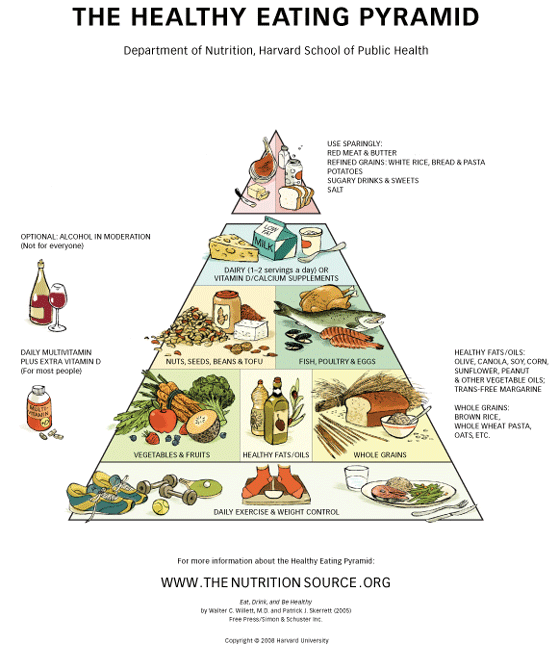
In fact, the Harvard School of Public Health drew up a complete alternate food pyramid to promote what they suggest should really be in a proper diet.


Here's the part that the Hymans of the world won't tell you. The Healthy Food Pyramid contains dairy. It has this to say.
Dairy (1 to 2 Servings Per Day) or Vitamin D/Calcium Supplements

Building bone and keeping it strong takes calcium, vitamin D, exercise, and a whole lot more. Dairy products have traditionally been Americans' main source of calcium and, through fortification, vitamin D. But most people need at least 1,000 IU of vitamin D per day, far more than the 100 IU supplied by a glass of fortified milk. (See the multivitamins section, below, for more information on vitamin D needs.) And there are other healthier ways to get calcium than from milk and cheese, which can contain a lot of saturated fat. Three glasses of whole milk, for example, contains as much saturated fat as 13 strips of cooked bacon. If you enjoy dairy foods, try to stick mainly with no-fat or low-fat products. If you don't like dairy products, taking a vitamin D and calcium supplement offers an easy and inexpensive way to meet your daily vitamin D and calcium needs.

That's not exactly in line with Willett's older pronouncements. The needs and the evidence has indeed changed over time.

And compare this:
Choose fat-free or low-fat milk, yogurt, and cheese. If you choose milk or yogurt that is not fat-free, or cheese that is not low-fat, the fat in the product counts as part of the discretionary calorie allowance.

If sweetened milk products are chosen (flavored milk, yogurt, drinkable yogurt, desserts), the added sugars also count as part of the discretionary calorie allowance.

For those who are lactose intolerant, lactose-free and lower-lactose products are available. These include hard cheeses and yogurt. Also, enzyme preparations can be added to milk to lower the lactose content. Calcium-fortified foods and beverages such as soy beverages or orange juice may provide calcium, but may not provide the other nutrients found in milk and milk products.

That sound awfully similar, doesn't it? Know where it comes from? From the new, revised government MyPyramid Food Pyramid.


Notice the difference between the two? The Harvard pyramid is incredibly complicated. The consuming public is not. In one of the posts on the conference I talked about the problem of comprehension a frightfully large percentage of the American population has with even the most basic food terms. The new Food Pyramid was drastically simplified because of this very problem. In fact, read how wonderfully easy-to-understand the new presentation is:
Six swaths of color sweep from the apex of MyPyramid to the base: orange for grains, green for vegetables, red for fruits, a teeny band of yellow for oils, blue for milk, and purple for meat and beans. Each stripe starts out as the same size, but they don't end that way at the base. The widths suggest how much food a person should choose from each group. A band of stairs running up the side of the Pyramid, with a little stick figure chugging up it, serves as a reminder of the importance of physical activity.

MyPyramid contains no text. According to the USDA, it was "designed to be simple," and details are at MyPyramid.gov.

That's taken directly off the Harvard Healthy Pyramid page.

I left off a few sentences, though.
Unless you've taken the time to become familiar with the Pyramid, though, you have no idea what it means. Relying on the Web site to provide key information—like what the color stripes stand for and what the best choices are in each food group—guarantees that the millions of Americans without access to a computer or the Internet will have trouble getting these essential facts.

The USDA also chose not to put recommended numbers of servings on the new Pyramid because these differ from individual to individual according to weight, gender, activity level and age. Instead, it offers personalized Pyramids at MyPyramid.gov.


That's a problem, although not a completely fair one. The government provides a wide variety of print materials, some targeted at Spanish-speaking audiences, mothers and mothers-to-be, and different ages. I'm sure America is awash in print explanations of the Pyramid.

The other legitimate objection is that MyPyramid is not accurate or give specifics. Notice that the Healthy Food Pyramid has a dozen parts.

That's the big issue. I face it every time I sit down at the keyboard and so does every other writer about health, diet, and nutrition. How much information to give? How much to simplify? What understanding can you assume your audience has? Will they get confused by too much detail or suffer if detail is slighted?

Harvard and the government came down on very different sides of this issue. I've given you both. Read them, download them, print out the posters. Decide for yourselves.

Bookmark and Share

Monday, April 19, 2010

Report From the LI Conference, part 27

Part 27. Hey, I sat there for a day and a half. Think how I feel.

Anyway, this was the last presentation.

Psychological Impacts: Strategies Effective in Managing Individuals Diagnosed With Lactose Intolerance
Janet E. Taylor, M.D., M.P.H.
Psychiatrist
Private Practice

Dr. Taylor wrote that "Undiagnosed individuals with gastrointestinal complaints may present with somatization preoccupation." How many of you out there know what somatization preoccupation is? If you do, you were one up on me. I had to look it up.

Somatization disorder refers to the preoccupation with multiple physical complaints suggestive of a somatic disease for which a clear physical etiology and an adequate medical explanation cannot be found.

In shorter words, you're sick with a real physical, as opposed to psychological, disease but no one can tell you what you have. Lactose intolerance should be easily diagnosed, but often isn't. And many people have a range of gastronintestinal disorders that may overlap with or be confused with or be suffered in addition to LI. I also have irritable bowel syndrome, and needed to find a treatment for that before my intestinal complaints could be brought under control.

Disorders that aren't quickly and properly identified lead to long-term distress of many kinds. More suffering, more sick days, more disruption. The psychological complaints that you didn't have in the beginning, like depression or anxiety, can result from not having the physical side go untreated.

Physicians have to become more aware of these psychological issues and look for signs of them and learn how to treat them as well as the physical illnesses.

There's more.

Here's a real problem that is almost never talked about when health is being debated. As many as 30% of adults in this country are functionally illiterate. They read at a fourth grade level or less. They may not know basic terms like "serving" or "calcium." They're probably not reading blogs, much less books or medical journals. The nutrition information on a package is probably confounding. The list of ingredients may not be understandable. They may not go regularly to doctors and if they do they're probably more concerned about other, urgent, health care needs.

I'm addressing this blog to a literate, probably well-educated population. That turns out to be only part of what needs to be done. All of the people in the U.S - and elsewhere - need the best health and the best information to achieve it, not just 70%. If you have any ideas on how that might be possible, please let me know.

Bookmark and Share

Sunday, April 18, 2010

Report From the LI Conference, part 26

We're back to another round of lactose intolerance influences people to not have dairy which lowers their calcium intake which has long term effects. The difference here is that Dr. Johnson looked at people's feelings as well as their behaviors.

Behavioral Factors Related to Lactose Intolerance and Bone Consequences
Susan L. Johnson, Ph.D.
Associate Professor
Department of Pediatrics
Section of Nutrition
University of Colorado Denver
Anschutz Medical Center

Most Important Problems Encountered With Having Lactose Intolerance

1 Not able to eat certain foods that you like

2 Worry about embarrassment at social events because of lactose intolerance

3 Limit your physical activity because of lactose intolerance

4 Concern about not getting enough calcium

5 Concern about developing osteoporosis or other bone diseases

6 Limit activities that take you away from available restrooms

The perceived inability to eat certain foods goes directly to milk drinking. Some people avoid all dairy products because of LI. But realistically, people don't stop eating their favorite foods like cheese, especially on pizza, and ice cream even if they are LI. That's probably why lactose-free ice cream never breaks through in the market.

One thing that's not known and would be helpful is whether adult perceptions of foods that "can't" be eaten because of LI affects the views of their children. Some children, especially Hispanic girls, were more likely than others to think of themselves as LI and so avoid dairy. If milk can be added to breakfasts, however, it's more likely to be drunk.

Bookmark and Share

Wednesday, April 14, 2010

Report From the LI Conference, part 23

The next presentation gives a useful follow-up to yesterday's post about the power of probiotics.

Treatment Recommendations in Adults With Diagnosed Lactose Intolerance
Jeanette N. Keith, M.D.
Associate Professor
Department of Nutrition Sciences
Department of Medicine
The University of Alabama at Birmingham

Probiotics can be helpful but people shouldn't expect to have them work instantly. In fact, any new dietary plan takes times to be effective.

In practice, we explain that just as it takes about 21 days to learn a new behavior, adaptation of the gut to a lactose-containing diet generally requires 3 weeks of consistent dietary change to achieve full tolerance.

As a nutritionist, rather than a research scientist, Dr. Keith had some crucial points that all practicing doctors should remember.

Patients like specifics rather than generalizations. That's the toughest thing for me to do, since I don't know you, don't know your medical history, don't know your symptoms, don't know all the little details that make up a life. Most of my advice here is generalized squared.

Doctors should do better, but too often they don't. A probiotic, for example, isn't a magic pill. Bacteria take time to multiply and drive out competing strains. If a doctor tells you to try them but nothing more, what do you do if you don't see improvement in three days? Or even a week? Many people would toss the probiotic and curse the doctor for making them spend unnecessary money. I'd much rather come out of a doctor's office knowing that I might have to wait for three possibly agonizing weeks for that wonderful symptom relief, even if I went in wanting that bit of magic.

Lactose intolerance is not a disease, despite what far too many people - and patients - think. The symptoms are all too real, though. Doctors need to understand what to ask about how people really eat, what tips to give, and how to steer individuals in the right direction.
The most effective dietary intervention for lactose intolerance is the one personalized to meet the needs of the individual affected by symptomatic lactose ingestion.

When you see your doctor, you need the best advice for you. Personally. I hope doctors are reading this.

Bookmark and Share

Wednesday, March 24, 2010

Report from the LI Conference, part 15

Scientists are nothing is not methodical. After examining the consequences of dairy avoidance in children, you couldn't have found a sports book in all Las Vegas that would be willing to take money against what the next panel would be.

Consequences of Excluding Dairy or of Avoiding Milk in Adults
Robert P. Heaney, M.D., FACP, FACN
John A. Creighton University Professor
Osteoporosis Research Center
Professor of Medicine
School of Medicine
Creighton University

To no one's surprise, Dr. Heaney found that adults who think they have lactose intolerance tend to avoid dairy. And in fact, studies have found anywhere from 33% to 80% lower calcium intake in lactose intolerant populations.

Part of his talk did differ from expectations. In what should also be to no one's surprise, taking a properly close look at the nuances give a picture of reality at odds with conventional wisdom.

But it is an oversimplification to focus exclusively on single nutrients, even calcium. Nutrients are not drugs, and they do not act in a vacuum. Rather, like the instruments in a symphony orchestra, they produce their effects in concert with one another. A striking example of this mutual dependence is seen in the interaction of calcium and protein in the diet. Until recently, high protein intakes were considered to be potentially harmful for bone because of their effect on urinary calcium excretion. Increased calciuria was clearly demonstrated for protein and for pure amino acids, whether taken orally or intravenously. However, when protein was fed as a food, strangely there was no effect on calcium balance. More recently, it has become clear that calcium and protein, rather than antagonists, are actually synergistic in their skeletal effects. In postmenopausal women with low protein intakes, increasing calcium intake can slow bone loss, but not much more. By contrast, with high protein intakes, added calcium leads to actual bone gain. This is an important consideration in our context because individuals with low dairy intakes are missing not only the calcium but also a rich source of dietary protein, which is as necessary for bone rebuilding as is the calcium that is the more obvious component of bony material.

In brief, dairy supplies a broad spectrum of nutrients that work together better than gaining them individually or from foods less gifted. Even calcium-fortified orange juice isn't anywhere as good a source as dairy.

And here's a tidbit that will infuriate those who cherry-pick the medical journals for anti-milk reports.
While the focus of this session is predominantly on skeletal effects, it should be stressed that inadequate dairy intake has multiple other consequences as well, including increased risk of metabolic syndrome, hypertension, preeclampsia, obesity, and certain forms of cancer, particularly colon cancer. Thus milk avoidance is, for most adults, a risky behavior.

Reality is a harsh mistress.

Bookmark and Share

Friday, February 05, 2010

Wanted: Single Lady. Must Be Lactose Intolerant

Humans, those of us who are members of the genus Homo, have been around for well over two million years. Homo sapiens emerged a good 200,000 years ago. Yet farming, animal and plant domestication, herding, and therefore milking have existed for less than 15,000 years. The math is irrefutable. Even modern humans spent move than 90% of their existence without milk or dairy products as a part of their diet. This also has to be true for most grains, as well as the fruits and vegetables that are part of the western diet. You never hear the anti-milk crazies mention that when they say that humans are not "designed" to digest milk.

Humans are omnivores. They can eat anything. Their digestive systems are different from either carnivores or herbivores and they have the digestive enzymes to break down any food into amino acids, fatty acids, and simple sugars.

Yet there is an argument to be made that all that genetic heritage must have some effect. It's an argument similar to the ones saying that we are not "designed" to sit in chairs, sleep in beds with pillows, and drive everywhere. Not to mention that we are "designed" to squat rather than sit while eliminating waste.

So what did humans eat for that first 99+% of their Homo years? Meat, fish, vegetables, fruit, roots, and nuts. Mushrooms, eggs, seeds, and lots of insects. Anything we could scavenge, trap, or pluck. Nothing deliberately grown. Or fermented (think wine, beer, and koumiss). Or processed (like, coffee, tea, or chocolate and especially not sugar). Definitely not vegan, either, since we used every part of the animal and broke bones to drink the marrow. We certainly didn't scorn plant material, of course. Estimates are that we might have scrounged some 200 species of greens. This diet would be low in carbs (although high in fiber) and probably low in fat, since wild animals are normally extremely lean. We've bred animals to add fats since we started domesticating them.

Walter L. Voegtlin was the first to advocate eating as are ancestors did in the The Stone Age Diet, a book he had to self-publish in 1975. The notion gained academic support after medical journal articles and the book The Paleolithic Prescription: A Program of Diet & Exercise and a Design for Living, S. Boyd Eaton, Marjorie Shostak, & Melvin Konner appeared in the 1980s.

The latest advocate for living a pre-civilization lifestyle (literally so, since the rise of cities - the basis for civilization - are based on the rise of farming and herding) is John Durant, founder of Hunter-Gatherer.com. He's single, ladies, and he's looking for a lactose-intolerant (and possibly even gluten-intolerant) wife. He said so in so many words on Stephen Colbert. Here's the clip.

The Colbert ReportMon - Thurs 11:30pm / 10:30c
John Durant
www.colbertnation.com
Colbert Report Full EpisodesPolitical HumorEconomy


Bookmark and Share

Monday, January 18, 2010

Whole Milk or Low Fat? The Answer's Not Clear.

Whenever the professional nutritional community discusses the use of dairy products, they always recommend using low-fat or even fat-free milk and dairy products. Courtney Helgoe argues that this advice may be totally wrong in an article for Experience Life Magazine.

Her argument is interesting, although not completely convincing. She highlights a major problem, one that I constantly complain about, that there are far too few good studies about the role of an individual food in the totality of our diets and many of the ones that exist are not as comprehensive as people make them out to be.

However, what makes her argument less than it could be is that she keeps talking about low-fat diets interchangeably with diets that use low-fat milk. There is no reason whatsoever to think that the people who take whole milk out of their diets are getting sufficient - or way too much - fat from other sources.

The entire article is interesting and well-researched and I recommend reading it with that caveat in mind.

Except. If the article were simply about the fat content of milk, I probably wouldn't bother to critique it at all. This is a blog about lactose intolerance. What jumped to my eye was a statement about the lactose in milk that I think is just plain wrong.

It's also likely that one will drink much more skim milk than whole (or eat more low-fat yogurt, fat-free sour cream, low-fat ice cream, etc.) for three reasons:

1.It generally takes larger servings of low-fat foods than full-fat foods to switch on our bodies' satiety signals.
2.There’s a psychological tendency to feel that because we're "being good" by eating these low-calorie, low-fat products, we are justified in "making up for it" by eating more of them — or more of something else.
3.Low-fat foods don’t keep us satisfied for as long and may also destabilize blood sugar, so we're likely to experience cravings to want to eat again sooner.

This last point deserves some explanation: Low- and no-fat dairy delivers more fast-absorbing lactose to the bloodstream, and more potential for corresponding insulin spikes and resultant sugar cravings. Full-fat dairy doesn’t have this effect. "The proportion of lactose decreases with every increase in milk-fat content," [Anne Mendelson in Milk: The Surprising Story of Milk Through the Ages] explains. So relative to skim milk, "heavy cream contains only minute amounts."

It's true that the lactose content of dairy products gets lower as the fat content gets higher. But the difference is hardly huge. "Minute" is the wrong word to use.

Check my Big List of Lactose Percentages. Heavy cream, which I have listed as whipping cream, has 60% of the lactose of skim milk. That's a difference, but not as significant as the quote would make out.

Lowering fats in your diet is still probably a good thing. If the only difference you make is to eat low-fat dairy products and you think that's sufficient you're wrong. Nor will taking out fats work if you devour tons of empty sugar calories. A good diet is a balance across all foods, all categories, all meals.

See table below for lactose percentages in fluid milks.


Fluid MilksRangeAverage
Regular Whole Milk3.7-5.1%4.8%
2% Lowfat Milk3.7-5.3%4.9%
1% Lowfat Milk4.8-5.5%5.0%
Nonfat (Skim) Milk4.3-5.7%5.2%
Chocolate Milk4.1-4.9%5.0%
Half-and-half4.0-4.3%4.2%
Light Cream3.7-4.0%3.9%
Whipping Cream2.8-3.0%2.9%

Bookmark and Share

Sunday, January 10, 2010

More Coconut Milk Goodness

With all the products that have come out in the last year that are coconut milk-based, you might be wondering whether to skip the intermediaries and start using coconut milk straight.

DaNae Johnson extols the virtues of coconut milk on Natural News.com

Coconut milk is high in saturated fat, nearly 25 grams (225 calories) in half a cup, but the fat in coconut milk is healthy fat. The fatty acids in coconut milk are of the medium chain triacylglycerol or MCT type. The distinguishing feature of MCTs so important to coconut nutrition is that they are burned faster than other types of fatty acids. They are especially beneficial for providing energy for the lymph nodes, liver, and fat cells themselves. (Even fat cells need energy.) ...

A little of the unsweetened coconut milk goes a long way. You probably don't want more than one cup of coconut milk in a two-cup smoothie. Store unused coconut milk in a glass container in the refrigerator or freezer. Or just use all the coconut milk at once to make an extra smoothie for a friend.

As with most natural foods enthusiasts, Johnson has never met a claim he doesn't believe. So he also states:
Using coconut oil in moderate amounts, up to about 2 tablespoons (30 ml) a day, in place of other oils, may help you lose weight (about 1 pound or half a kilo a month) even if you eat the same portions of other foods. You can get the same result from using 1/4 cup of coconut milk a day in your smoothies.

I know of no good studies that have shown that MCT or coconut milk can be used for weight loss. All studies so far have been inconclusive or require such high levels of coconut milk as to make the diet unhealthy. See Health.net for a more measured assessment of studies involving MCTs.

Bookmark and Share

Wednesday, December 23, 2009

Good Afternoon, Calgary

A little late, unless they do reruns or repeats, but I did a live interview with Canadian radio station CHQR today. Mike Blanchard interviewed me to get my reactions on an article that had appeared in the Toronto Globe and Mail called "Is milk good for your kids?"

Hey, you know me. Try to pin me down on a complicated, contentious subject and I strike back with a forthright "Yes. And No." Which I believe strongly.

The article is mostly one sided, with eminent doctors citing studies that have shown some negative effect of milk. These articles are true but the kind of truth that results from not mentioning any studies on the other side, like those that show that low-fat milk can help control, even lower, high blood pressure and so lower hypertension. The alternative view is given by representatives of farmers groups, who unfairly are not given a chance to cite particular studies.

If you read carefully you see that even the nay-sayers are reluctant to remove milk from children's diet. They do question whether the Canadian government guidelines should proclaim it to be "essential".

I agree that milk is definitely not essential for those children and adults who are allergic to milk. A great many alternatives now can be found in stores, "milk" substitutes made from soy, rice, nuts, hemp, and coconuts. Parents need to compare the nutritional labeling to regular milk to ensure that the nutrients these "milks" contains are close to the original. With dozens of different brands and styles and market segments aimed for, ingredients often vary widely.

Those of us who are lactose intolerant can use these products as well, but we can also find ready-made lactose-free milk and other diary products or use lactase pills - several brands of which are made by Canadian companies - to reduce symptoms if you're having regular dairy products.

Dairy is well known for high calcium content in a palatable form. There is calcium in cheese and pizza and ice cream and custards and all the other delicious dairy products that are omnipresent in western food cultures. You can trying getting your kids to load up on green vegetables and fish for their calcium but many parents report that it's a harder job.

And there is a hidden danger of merely yanking milk away from a group likely to drink large quantities of it. The alternative is all too often not soy "milk" but soda. Sweet soda contains twice as much sugar per glass than milk does and has virtually none of the many nutrients milk is famous for, according to NutritionData.com:


In short:

• Know what problem you're trying to solve.
• Know both the pros and cons of the food you're concerned about and the food you want to replace it with.
• Learn whether your child will accept and adapt to the new diet.
• Learn to stop being frightened. Unless you child had a true allergy, which only affects 2-3% of children, and therefore must eliminate milk, dairy products are always an option. They may not be essential. They may not be necessary, since vegans can have perfectly healthy diet with the same kind of attention and intimate knowledge of their food that I suggest. But there is no good reason to think that they are actively harmful. The data is sketchy and limited. We need better studies all around before we start eliminating major food groups.

In the end it's a private choice for adults and a reasoned choice for parents of children. You can keep a child perfectly healthy and happy either way. Convenience, cost, and availability, especially of packaged food, restaurant meals, and eating with Friends and family, may become the determining factor.

You can find a middle course through the dueling experts. It's called common sense. Parents are good at finding that middle ground, even in a subject as contentious and poorly understood as milk and dairy.

Bookmark and Share

Sunday, November 08, 2009

Nutrition for Vegetarian Children

Emily Sohn in the Los Angeles Times gave a number of good tips for ensuring that children who want to be vegetarians continue to get a full complement of the vitamins, minerals, and esential dietary components.

Some of the major points:

Protein needs range from 13 grams for toddlers to 34 grams for middle-school students and about 50 grams for teenagers. However, most Americans get too much protein, including vegetarians.

Dairy products and eggs are complete proteins that, like meat, contain all essential amino acids. These foods also provide calcium and vitamin D, essential for healthy muscles and bone development, especially during growth spurts and adolescence. One large egg contains 5 grams of protein, a cup of milk has 8 grams, and a cup of yogurt has 11 grams.

To get complete proteins from plant-based sources, you need to combine foods such as beans, rice, corn, nuts and tofu, but dietitians no longer believe that you need to eat those foods at the same meal. Eating a variety of foods throughout the day works just as well.

Vitamin B-12 is one of the nutrients that vegetarians most commonly miss. Essential for making DNA and maintaining healthy nerve and red blood cells, it is plentiful in seafood and beef and is found in lesser amounts in milk and yogurt. Vegans can get it from fortified cereals or supplements. Doctors often recommend B-12 supplements for breast-feeding mothers who are vegan.

Iron, which is abundant in meat, is present in a harder-to-absorb form in beans, tofu, spinach and raisins. Absorption is enhanced by consuming a source of vitamin C at the same time as a vegetarian source of iron, says Ruth Frenchman, a registered dietitian in Burbank and spokeswoman for the American Dietetic Assn. (Pair a cup of orange juice with a peanut butter sandwich, for example.) ...

Calcium and vitamin D are found in leafy greens and fortified soy milk or juice. Make sure to look at the labels on dairy-free versions of milk and yogurt and on organic cereals because they're not always fortified with added nutrients.

Fat: A baby's brain needs enough fat to develop properly. The American Academy of Pediatrics recommends full-fat versions of milk, yogurt and other foods until age 2.

Bookmark and Share

Friday, October 16, 2009

Dairy-Free Chocolates Are Healthier

Chocolate has sometimes been mentioned as a healthy food. Turns out it's not all chocolates. They have to be... Dairy-Free.

That's the claim made by this Premium Health News Service story by Lisa Tsakos of NaturallySavvy.com. I found it on the website of an Arkansas television station.

Q. Is chocolate actually healthy? I've heard a lot about the antioxidant properties of chocolate.

A: The antioxidants (polyphenols) in chocolate are very powerful -- as long as no dairy has been added. Research shows the health benefits of chocolate (or cacao) are negated with the addition of dairy. Bottom line: Yes, dairy-free chocolate can be healthy (the more antioxidants the better), however, those same nutrients can be found in tea and red grapes. So as much as we'd like to think of chocolate as an "essential" food ... oh, go ahead, eat it anyway.

Is this true? Are there any studies on this?

Who cares? I love dark chocolate! (70-72% cocoa powder content is best.) Do you think I'm going to even try to disprove such a wonderful report? Facts that you want to hear are always true!

Fortunately for my morals and ethics, Lisa Tsakos' contention is backed up by some scientific research.

A story by Daniel J. DeNoon on WebMD in 2003 reported on an Italian study.
Dark chocolate -- but not milk chocolate or dark chocolate eaten with milk -- is a potent antioxidant, report Mauro Serafini, PhD, of Italy's National Institute for Food and Nutrition Research in Rome, and colleagues. Their report appears in the Aug. 28 [2003] issue of Nature. Antioxidants gobble up free radicals, destructive molecules that are implicated in heart disease and other ailments.

"Our findings indicate that milk may interfere with the absorption of antioxidants from chocolate ... and may therefore negate the potential health benefits that can be derived from eating moderate amounts of dark chocolate."

Nature is one of the world's premier science journals. Did I mention that they printed a story of mine on their back page "Futures" section that features one page science fiction hard science stories? It's in the September 24, 2009 issue for those with access to bigger libraries. (Or you can buy it as part of my collection of short stories Tyrannosaur Faire. Its title is "A Kiss Isn't Just a Kiss".) Why didn't I tell you about it sooner? Because I didn't know when the story was going to be published and I only found out about it when they sent me an issue - an issue that didn't arrive until the next week's issue was already out.)

Digression, Sorry.

I have to point out that this study was on a grand total of 12 people and only tested their blood an hour after eating so there's no way of knowing whether any long-term good was done.

ScienceDaily.com reported on a different study from the U.S. Agricultural Research Service (ARS) in 2005. The ARS is the chief scientific research agency of the U.S. Department of Agriculture.
The researchers found natural cocoa powders contained the highest levels of TAC and procyanidins, which were found to be the dominant antioxidant in chocolates. Milk chocolates, which contain the least amount of cocoa solids, had the lowest TAC and procyanidin levels. Baking chocolates contained fewer procyanidins, because they contained more fat (50-60 percent) than natural cocoa. Alkalinization, used to reduce the acidity and raise the pH of cocoa, such as Dutch chocolates, was found to markedly reduce procyanidin content. Researchers concluded that chocolates containing higher amounts of cocoa ingredients have higher procyanidin contents, therefore, higher antioxidant capacities.

Nine major manufacturers provided commercially available chocolate and cocoa samples and the National Institute of Standards and Technology provided its Standard Reference chocolate for analysis. The study was partially funded by a grant from the American Cocoa Research Institute.

Wait. The National Institute of Standards and Technology has a "Standard Reference Chocolate"? Why isn't this better known? Why aren't there public tours?

Anyway, other research indicates that the chocolate should be at least 70% cocoa for best results, a nice bittersweet amount. (I find that anything over 80% is too bitter, but I'm extremely sensitive to bitter tastes.) Remember that the rest of the chocolate will be fat, so don't overindulge.

There are zillions of dark chocolate bars on the market. I've tried many and found that they are remarkably different from one another. Unfortunately, the more expensive ones really are better. You can get good results inside a good supermarket if you explore the shelves carefully and sample the brands. If the bar doesn't tell you the cocoa percentage you can assume that it isn't high enough.

Dark chocolate. Daily. Have a piece while checking out my blog. Both are proven to be good for your health.

Bookmark and Share

Wednesday, September 23, 2009

Free-From Foods Not Free From Salt

Food is great stuff. It's delicious in a thousand different ways, but mostly because humans have adapted over hundreds of thousands of years to the components of foods. This works in two different ways. First, there are the distinct sensations conveyed by our "taste buds." Sweet, sour, salty and bitter, and possibly a fifth sometimes called umami or savory. We're particularly prone to find sweet and salty foods delectable but are likely to be repelled by bitter and sour tastes. Children find the latter especially yucky and this may guide them to sweet and salty foods which they retain a preference for as adults.

We're also adapted to like the taste of fats even more than other components of food, presumably because fats pack more than twice the caloric density of proteins or carbohydrates and that could mean survival in the wild.

Most inhabitants of western countries today find it more than easy to get all the fats they need today just as it's easy to find the once rare and precious sweetener we know as sugar. Most nutritionists will argue that we eat way too much fat and sugar. And salt, for that matter.

So for years food scientists have slaved over their test tubes and test kitchens trying to create food that is fat-free or sugar-free or salt-free or all three that tastes just as good as the originals. Most of the time they fail. "Free from" food as it's sometimes called, more usually in the U.K., has a distressing propensity to taste like cardboard. So the scientists cheat. They'll sometimes load up fat-free foods with sugars just to give our palates something to play with on the way down, for example. Nutritionists tend to go into palpitations at such antics, and for good reason.

Now comes the distressing news that a study of house brands at five British supermarket chains finds them loading up the free from dairy-free or wheat-free foods with tons of extra salt. Salt has the property of enhancing flavor, which is why a pinch - or more - of salt is added to about everything. But this BBC News article reported that the chains go a lot farther than that.

Sainsbury's Free From Jaffa Cakes have 0.67g of salt per 100g, compared with 0.1g of salt per 100g in standard Sainsbury's Jaffa Cakes.

This is more than six times the salt level of the standard version.

Morrison's standard Chocolate Chip Cookies contain 0.5g of salt per 100g, while their Free From version contains 1.5g per 100g - three times as much.

ASDA Free From Double Chocolate Muffins have over three times as much salt as ASDA Double Chocolate Muffins, 1g per 100g as opposed to 0.3g per 100g.

Tesco's Free From Victoria Sponge has more than double the amount of salt as its standard cousin, 1.4g per 100g compared with 0.6g of salt per 100g.

Do free from products need to have this extra salt to taste good? Not necessarily. Each supermarket has some product equivalents with lower salt.

While the impact of salt on health has been hotly disputed of late, "free from" foods should be approximately equivalent to their regular counterparts and there's no good reason to load them up with salt.

Does this mean that I'm recommending yet more ingredients list reading in the supermarket? I'm afraid so. Don't get so happy at finding a dairy-free product that you toss it unthinkingly into your grocery cart. (OK, you can do it once.) Check closely how those canny food scientists are achieving the feat. Dairy-free should never mean unhealthy.

Bookmark and Share

Thursday, May 21, 2009

Fiber for Dairy-Free and Gluten-Free Diets

Katherine Hobson writes the "On Fitness" column for U. S. News & World Report. That particular linked column answered a question of considerable interest to us.

Q. What are the most effective sources of dietary fiber for those who are on gluten-free and lactose-free diets?

A. Beans and legumes would probably be the most effective. You might also consider cooked or stewed vegetables, which are easier to consume. Generally, fruits are low in fiber and relatively high in calories and sugar, so they're not a great fiber source.

She got the answer from Joanne Slavin, a professor of food science and nutrition at the University of Minnesota and author of the American Dietetic Association's 2008 position paper on dietary fiber.

Bookmark and Share

Tuesday, March 03, 2009

Healthy Ideas Nutritional Labeling Program

Peapod.com, the online grocery shopping and delivery site, announced that it has joined in Healthy Ideas, making it part of its NutraFilter selection sorter.

NutriFilter acts as a virtual nutritionist, reading product labels and highlighting items that fit a shopper's specific health and nutrition needs from categories like Gluten-free to low-sodium. With the introduction of the Healthy Ideas labeling plan, Peapod shoppers can quickly identify foods that have less fat, saturated fat, cholesterol and sodium. Healthy Ideas items are also guaranteed to be a good source of at least one nutrient, including protein, fiber, vitamins A or C, or the minerals calcium or iron. ...

NutriFilter is available to anyone who visits Peapod.com. Shoppers simply choose from nine programs including Dairy-free, Egg-free, Gluten-free, Healthy Ideas, Peanut-free, USDA Good Fiber, USDA Low Fat, USDA Low Sodium and Weight Watchers(R). Shoppers search and shop on Peapod as usual, and the items in each category that meet the selected program's criteria will be displayed at the top of the list and clearly identified by the plan icon.

Healthy Ideas was instituted by the bricks and mortar real world supermarket chains Stop and Shop and Giant Foods, sister chains that have 561 stores in the Northeast U.S. Their parent company, Netherlands' Royal Ahold, also owns Peapod. Peapod is similarly limited in its distribution to the Northeast and a few other metro areas.
Founded in 1989 as a smart shopping option for busy people, Peapod today stands as the country's leading Internet grocer, serving the metro areas of Boston, Chicago, Hartford, Milwaukee, New Haven, Providence and Washington, D.C., Suburban New York City and communities in the states of Connecticut, Indiana, Illinois, Maryland, Massachusetts, New Jersey, New York, Rhode Island and Virginia.

Timothy W. Martin wrote about Healthy Ideas' introduction in the Wall St. Journal
The "Healthy Ideas" system will distinguish more than 3,000 of the stores' products and fresh produce with a bright green-and-blue symbol signifying they meet U.S. Department of Agriculture and other federal guidelines defining what makes a food healthy. That represents about 10% of the store's total inventory and includes items ranging from dairy products to pancake mix to frozen Brussels sprouts....

Healthy Ideas is one of several new food-labeling programs that attempt to simplify the identification of nutritious foods. The more-detailed nutritional labels required by the Food and Drug Administration have confused some consumers who might not be able to parse the differences between the benefits and drawbacks of reduced fat versus reduced sodium. And not everyone agrees on what makes a food healthy, leading to criticism of the programs over which items get included....

The new programs try to distinguish which products in a given category -- cookies, for instance -- are healthier than others in that category. "Not all cookies are created equal," says David L. Katz, director of the Yale University Prevention Research Center.

Bookmark and Share

Saturday, July 12, 2008

Detox Your Brain, Not Your Diet

Detox diets are the latest food fad quackery, mystic nonsense that play on consumers' fears and ignorance. Oprah is partly to blame, as she so often is. She embarked on a much-publicized 21-day vegan detox diet. Then she ate her way through Italy, according to the Los Angeles Times.

Now MSNBC.com has given ultra-huckster Mark Hyman, author of the UltraMetabolism series of cookbooks, space to spread his detox mishmash.

The bottom line is that quality is MUCH more important than quantity. Eating only whole, fresh, real food completely eliminates the need for calorie counting, or measuring fat grams or counting carbs.

This works for one simple reason — you eat not only calories but also information. Eat the wrong information and you give your genes instructions to make you fat. Eat the right information and you give your genes instructions to lose weight. This is based on an exciting new understanding of how food talks to your genes called nutrigenomics.

And it doesn’t work slowly over years, but literally in minutes.

Most doctors who aren't trying to huckster their books think that detox diets are phony. They say that the body simply doesn't work like this.

The BBC did a non-scientific test of a detox diet:
We took ten party animals to a country cottage retreat for ten days to see if a detox diet could recharge their internal batteries. The group was split into two and half the girls were put on a balanced diet, including red meat, alcohol, coffee and tea, pasta, bread, chocolate and crisps (in moderation), with the remainder following a strict vice-free diet.

Can a short, sharp shock really change the levels of toxicity in your body in just a week?

After testing the kidney and liver functions and measuring the antioxidant and aluminium levels in their blood we found there were no differences between the groups.

Of course, such a stunt test has no scientific value. But it is just as sound as the non-science that's used by the detox gurus to plug their books.

One thing most of the detox diets have in common is the magnification of dairy allergy as a problem. Very few adults have dairy allergies without knowing it, but claiming that it's a common problem that the detox diet can fix will cause the unaware to assume that any improvement they feel is the result of the elimination of that allergy.

Now it's certainly true that whole fresh food is usually good for you. And it's certainly true that most Americans eat too much of the wrong foods, dine at restaurants that pile too much fat and sugar onto plates, and snack unhealthily. You don't have to give up all food with a label to improve your diet over this. Most people who aren't food faddists can't afford to spend multiple times the money they spend today for exclusively fresh and unprocessed food, or spend the hours needed to cook these foods immediately before they spoil. Hyman and his ilk appeal to the idiot affluent, rather than the people with the documented health problems.

Don't fall for detoxing. Don't - and I know this is heresy - listen to Oprah for food advice. (You guessed it, her pet doctor Mehmet Oz is another food faddist.) Buy good foods that you can afford. Eat less, and exercise more. Don't expect your food to talk to your genes. Let your brain do its work.

Bookmark and Share

Tuesday, May 27, 2008

Lactose: How Low Is Zero?

The Advertising Standards Authority in the UK gets to judge advertising claims and their truthfulness. In April, they had to judge a case involving lactose, as shown in this summary by Susan Barty and Susie Carr on Mondaq.com.

Arla Foods Ltd, 23 April 2008

A TV ad, for Lactofree milk, stated "Lactofree, the full taste of real milk, just without the lactose". Text on the packaging stated "with less than 0.05%" lactose.

Complaint / Decision

Two viewers claimed that the ad was misleading and potentially harmful, because they considered that the product contained 0.05% lactose.

Complaint not upheld: The advertiser produced UK-accredited tests, which it had undertaken, to demonstrate that Lactofree contained 0% lactose but at a detection level of 0.05%. The ASA understood that it was generally accepted that the lowest amount of lactose that could trigger symptoms in an individual who was lactose intolerant was 5g. Lactofree was well below the 5g margin and was therefore unlikely to have any effect on someone who suffered from lactose intolerance the ASA concluded that the ad was unlikely to mislead or cause harm to viewers.

That summary confused me the first time I read it, so let's take it apart piece by piece.

First, we have to look at how nutritional information is presented on packaging. Information has two parts: accuracy and precision. Recipes, even for standardized commercial goods, are hard to perfectly regulate. One batch may have slightly varying amounts of fats or vitamins or calories than another. That makes accuracy an issue, with the amount of any individual item usually an average taken over many test batches. Say that the average amount of fat in a cookie is 5 grams. How precise is that number? Is it really 5.0 grams? 5.019093873975499383983983900498409808 grams? 4.99976 grams? There's a limit to how many decimal places can be measured by the best equipment, and no need to use the best equipment in the first place. In practice nobody can tell the difference between those three amounts. Trying for that level of precision is silly and confusing. In the U.S. amounts are always rounded to the nearest half gram.

What happens, then, if the amount is less than a half (0.5) gram? In the U.S. manufacturers are allowed to round down to 0. That's right, many times when you see a listing of 0 grams per serving of an item you can't assume that nothing is there. A famous example occurs when cheeses prominently list 0 grams per serving of lactose. There may truly be 0 grams. But there also may be, say, 0.4 grams. For a one-ounce serving that's 1.4% lactose. Not much, but not insignificant.

Other types of rounding are also allowed. A product with fewer than 5 calories per serving, say, a sugar substitute, is legally allowed to bill itself in the U.S. as having 0 calories when it really might have a calorie or four.

In the U.S., lactose has a further twist. You can report 0 grams of lactose per serving and not have zero lactose, but if you use the words "lactose free" then it better be 100% free of lactose. Or at least 100% free within the precision of whatever testing equipment is used.

That brings us back to Lactofree. In the U.K., apparently, the testing precision for lactose in milk allows for up to a 0.05% variance.

That's not much. A liter of cow's milk has about 40 grams of lactose, so 0.05% of that is 0.02 gram (or about 0.005 gram in a standard 8-ounce American glass). Absolutely minimal.

The ASA said that was within standards and too low to affect even those who were lactose intolerant. They dismissed the complaint.

I agree that this is a reasonable ruling. One sentence does worry me, though. "it was generally accepted that the lowest amount of lactose that could trigger symptoms in an individual who was lactose intolerant was 5g." Really? That's saying that anybody can have 1/8 of a liter (about three ounces) of milk without symptoms. Most people can, true. But everybody? I'd like to know where they got that standard. It's nothing I've ever seen before.

I accept that Lactofree milk has as little remaining lactose in it as their manufacturing process can make it. It's not as clear whether little is the same as zero or just equal to "very small." A very tiny number of people who say they can't have even the slightest amount of lactose might want to stay away from Lactofree. On the other hand, if your symptoms aren't too bad you might want to take a test drink and see whether the "not even the slightest amount" clause is really true or whether you're underestimating your capacity.

The broader lesson for all of us is that just reading the nutrition numbers on the side of a package is nowhere near sufficient. You have to research deeper to understand where the numbers come from, what they mean, and what variants are legally allowed. You can bet that the manufacturers know the rules down to the last letter and are manipulating them to their advantage every chance they get. You have to be as smart as they are. Never let up your guard. They are always trying to slip a new twist past us. Don't ever let them.

If you have questions about what the numbers on packaging mean, drop me a line at stevecarper@cs.com. I'll try my best to sort the numbers out from a to z.

Bookmark and Share

Sunday, May 25, 2008

Health Magazine's Healthiest Restaurants

Americans go to chain restaurants, not healthy ones. There are salad bars, and pricey little gourmet restaurants, and even a wannabe chain like Rochester's Tasteology, which is trying to figure out a way to serve tasty 500-calorie meals.

But when most Americans dine out they wind up choosing heart-attack-on-a-plate glop like Chili’s Crispy Honey Chipotle Crispers, which manages to load 1,890 calories on you before adding dressing, or O’Charley’s Onion Rings with Cajun Horseradish Sauce, whose 139 grams of fat is two full days of normal fats in one side dish.

Health Magazine surveyed 43 sit-down and 53 take-out chains to find which had the healthiest dishes alongside the glop.

The winners have plenty of dishes with calories galore. Apparently, they have better choices that you can decide to concentrate on the next time you're out. And many of the best aren't heavy on the dairy products, making them good choices for the lactose-intolerant community.

Here's a very brief summary.


Noodles & Company
noodles.com

We love: The Trio—soup, noodles, or salad paired with your favorite protein, plus a side salad or a cup of soup.

Chipotle Mexican Grill
chipotle.com

We love: Anything with the chipotle-adobo-marinated grilled steak.

Cosi
getcosi.com

We love: The delicious, healthy fruit smoothies in a green tea base.

Panera
panerabread.com

We love: “You Pick Two” combos. You can get half a sandwich paired with a vegetarian soup

Au Bon Pain
aubonpain.com

We love: The restaurant’s recent move to using preservative-free chicken, for better flavor and less sodium.

Bookmark and Share

Wednesday, January 30, 2008

Worst Case Result if You're Lactose Intolerant...

... you might have to go on reality television.

The horror! The horror!

Before you avert your eyes in sheer mortification, here's some helpful reassurance. It wasn't the lactose intolerance that was the problem. That was a mere trigger for the nutty food intolerances-are-everywhere idiocy that is consuming the U.K.

I take this from the most reliable possible source, Kim Gregory's article on ShowBizSpy.com.


Yasmin Smith was legitimately diagnosed with lactose intolerance. Unfortunately, she assumed that if she felt better by removing one food from her diet, she would feel multiply so by wiping out all dairy. And wheat. And fish. And fast foods. And foods with preservatives and additives.

Her underlying problem was an eating disorder rather than any organic allergies.

Her cure was suitably drastic. She went on the reality show Supersize vs Superskinny and was forced to swap diets with a man who weighed 462 pounds (33 stone).

I have my doubts whether stuffing herself with cockle pizza and blood pudding managed to cure her of anything but a liking for cockle pizza and blood pudding. However, she also spent a week in a clinic and was sent home with a 12-week healthy eating program.

Yasmin gained back seven pounds and four inches around her stomach and hips. She said:

"I’ve learned not to fear food anymore. I feared food because I put all my worries of my intolerances from lactose all in one and combined them unnecessarily.

"It’s brilliant and means I can lead a normal life again."


Please don't fear food. Food intolerances and allergies can be challenging but should never be limiting, not with so many alternatives and substitutes on the market today. Yasmin's diet of fresh fruits, vegetables, and lean meat is the basis for a healthy diet but shouldn't be the whole of it as she had it. Moderation in all things except moderation. And reality television. Strict avoidance is the only hope.

Bookmark and Share

Wednesday, January 16, 2008

Bunches of Dairy-Free Recipes

OK, I admit that at first glance, Cancer Center Recipes Just for You is not the most appealing come on I've ever seen.

Even so, click on "Recipe Search" when you get to that page. That'll bring up a screen that will allow you to search for only specific recipes in their database - only dairy-free or only vegan or only both, just for example.

The bunches pun in my title is there because the site is heavy on recipes containing fruits and vegetables. From that same search page, you can select which fruits and/or vegetables you want to make sure are in the recipes that are offered. When I ask it to give me vegan dairy-free recipes that contain cucumbers, I get five results.

You can play with the site for hours because hundreds of recipes are in the database.

With every sensible nutritionist (and even some of the crazy non-nutritionist diet gurus) recommending increased numbers of fruits and vegetables in our diets, a fruit and vegetable-based recipe resource is a great idea. Thanks to the University of Michigan Comprehensive Cancer Center for the work they did in putting the site together.

Bookmark and Share