IMPORTANT NOTICE ABOUT COMMENTS

COMMENTS HAVE BEEN DISABLED

Because of spam, I personally moderate all comments left on my blog. However, because of health issues, I will not be able to do so in the future.

If you have a personal question about LI or any related topic you can send me an email at stevecarper@cs.com. I will try to respond.

Otherwise, this blog is now a legacy site, meaning that I am not updating it any longer. The basic information about LI is still sound. However, product information and weblinks may be out of date.

In addition, my old website, Planet Lactose, has been taken down because of the age of the information. Unfortunately, that means links to the site on this blog will no longer work.

For quick offline reference, you can purchase Planet Lactose: The Best of the Blog as an ebook on Amazon.com or BarnesandNoble.com. Almost 100,000 words on LI, allergies, milk products, milk-free products, and the genetics of intolerance, along with large helpings of the weirdness that is the Net.

Friday, January 26, 2007

Take Your Vitamins

Who needs supplements of vitamins and minerals?

Family practitioner Dr. Deirdra Greathouse, with Provena Saint Joseph's Medical Group of New Lenox, said she only really recommends vitamins to three groups of her patients: those who are vegans, those who are lactose-intolerant, and women of child-bearing years.

That comes from an article at HeraldNewsOnline.com

Greathouse continues:
It's hard for vegans to get all the vitamins they need without eating animal products, she said, and lactose-intolerant people sometimes don't get enough calcium.


Chart from www.faqs.org

Women who might get pregnant must have folic acid in their systems before they actually conceive, or their babies might have a higher risk for birth defects.

But for her other patients, Greathouse said she recommends eating a varied and balanced diet that will naturally provide the nutrients our bodies need.

"Studies have shown that taking a daily multi-vitamin doesn't have any major benefits," she said. "Vitamins alone do not insure health."

...

Women who don't get enough calcium in their diets, she said, should take calcium supplements. The mineral protects us from bone loss and fractures. From about age 25 to 50, women need 1,000 mg calcium per day. Post-menopausal women over the age of 50 need at least 1,500 mg calcium a day, she said.


A sidebar lists some reccomendations and warnings:
• Calcium. Post-menopausal women need more, and most multi-vitamins don't contain enough. Take calcium supplements that are not part of multi-vitamins so you make sure you get enough.


• Chromium, selenium, and zinc are often missing from multi-vitamins.


• Vitamin K. Many multi-vitamins have little or no vitamin K, but research suggests vitamin K may reduce the risk of hip fracture. It does interfere with blood thinners, though, so ask your doctor.

Make Sure You Don't Get Too Much:


• Vitamin A acetate or palmitate (retinal). Too much can raise the risk of hip fractures.


• Vitamin E. Several trials have found that the risk of dying rose steadily as the vitamin E dose increased from 100 I.U. to 2,000 I.U a day.


• Iron. The highest safe level is 45 mg from food and supplements combined.


• Zinc. You need only 8 mg for women or 11 mg for men. Too much can make it hard to absorb or retain copper. It can also impair the immune system.

Source: Nutrition Action Healthletter, March 2006

Bookmark and Share

Thursday, January 25, 2007

"Rubbish" Says Dr. Miriam

The kerfluffle started by Allergy UK's moronic poll alleging to prove that one-third of the total British population has food intolerances and allergies continues to roil nicely.

You can check back to my first post, How Sick Are You, Brits?, which said:

A new report from Allergy UK has found that 45 percent of common health complaints in Britain are directly caused by food intolerance.

and the first response, Brit Docs: It's All In Your Minds, which reported that:
"True food allergy is comparatively rare, affecting perhaps 8 per cent of children and 4 per cent of adults," [Food Intolerance Network co-founder Dr Howard Dengate] told FoodNavigator last year.


Today the doughty Dr. Miriam weighs in, sounding like a scolding nursery school teacher in an article in The Mirror:


I've never heard such rubbish. And this particular rubbish is masquerading as "science" in a survey published a couple of days ago by Allergy UK, a medical charity.

The report feeds into the current fashion for food intolerance. And it's dangerous because someone suspecting they have an intolerance will feel free to go on an exclusion diet, omitting important, nutritious foods without prior diagnosis and without supervision.

As you might suspect there's a commercial agenda.

There are a number of commercially available tests for food intolerance that their manufacturers claim will make the diagnosis for you. They're suspect, unreliable and scientifically unproven. The commonest intolerance - lactose (milk) - is due to a shortage of the enzyme lactase, needed to absorb lactose.

...

Let's keep a sense of proportion here. With food intolerance you can usually get away with simply cutting down on the offending food.

And resist celebs who endorse wheat-free or milk-free diets.

Well, go, Dr. Miriam, whoever you are.

I could just wish you had stopped while you were ahead.

Unfortunately, you messed up with this little gem:
[I]f babies aren't given milk after weaning, their intestines think lactase is no longer needed and intolerance is the result.

Bzzz. Wrong.

Lactase production is shut down when and if the gene sends out the signal to shut it down. Whether you have or don't have milk makes no difference at all. You may lose the good bacteria in the colon that helps digest lactose if you avoid milk, but those are quickly regained either by eating yogurt or taking probiotics.

But the rest is good stuff. Allergies are serious. Intolerances are less so. But most Brits don't have either problem when it comes to dairy products. You also have a greater range of alternative products than you used to, as shown on my U.K. and European Lactose News page on my website. Milk is not a big deal. Neither is avoiding milk. Just stop being frightened of you food.

Bookmark and Share

Wednesday, January 24, 2007

Lactose Intolerance Support Group

Support groups for people with lactose intolerance are quite rare. I haven't heard of more than a couple over the years.

But one's forming in Greenville, SC, according to an article by Mike Foley online at GreenvilleNews.com.

Because lactose intolerance is so prevalent, a lactose-intolerance support group is forming locally. Organizers include Dr. Michael Kelly of Gastroenterology Associates; Karen Schwartz, a registered dietitian with Bon Secours St. Francis Health System; Whole Foods; and several national suppliers of alternative dairy products such as goat's milk and soy milk.

The first meeting is Jan. 30, from 7-8:30 p.m. at St. Francis Women's and Children's Hospital on Commonwealth Drive on Greenville's Eastside, in Classroom 201.

To register or for more information, call: (864) 268-1363. Space is limited to 25 people.

Know of groups in other cities? Let me know and I'll post them here.

Bookmark and Share

Tuesday, January 23, 2007

Brit Docs: It's All In Your Minds

Yesterday I posted a report, How Sick Are You, Brits?, about a disturbing poll conducted by Allergy UK. In a survey of 5,200 people the group found that 59 per cent of the people responding reported regarding themselves as having a food intolerance and 41 per cent considered that they had classical food allergy.

Not surprisingly, the doctors have struck back, claiming that people are at the very least confused.

An article, UK survey targets food allergy awareness at the FoodAndDrinkEurope.com site, quotes Food Intolerance Network co-founder Dr Howard Dengate.

"True food allergy is comparatively rare, affecting perhaps 8 per cent of children and 4 per cent of adults," he told FoodNavigator last year.

"It is a quick immune system-mediated reaction to the proteins in a few foods such as milk or nuts and can be confirmed by a laboratory test.

"Food intolerance, on the other hand, is common, reactions are a dose-related and typically delayed response to artificial or natural chemicals in foods, and many foods may be involved with a bewildering range of symptoms. As there are no scientifically proven laboratory tests, diagnosis is through the use of an elimination diet with challenges."

The article continues:
Many scientists will refute the findings as having any scientific basis. The figure of 41 per cent of respondents considering themselves to exhibit 'classic' food allergy symptoms is far higher than the figure of four per cent given by Dengate, and will fuel the opinion that consumers largely 'imagine' food allergies.

All this shows the importance of monitoring your food and your symptoms on a regular basis.

True intolerances or allergies aren't something that happens just once in a while, unless you're lactose intolerant and that's the only time you ever have large quantities of dairy products. Most people should see a correlation between having dairy - or other allergens - and having symptoms.

There are hundreds of foods that can cause simple diarrhea or other intestinal or stomach complaints. Poorly washed or inadequately refrigerated foods account for hundreds of thousands or millions of cases of mild food poisoning each year as well.

Medications, sugar substitutes, alcohol, and other non-food substances that you put into your mouth can also cause symptoms.

Figuring out after the fact which single ingredient caused a symptom is often impossible. But the reverse isn't true. If you suspect a single food, like dairy, to be the culprit, you can remove it from your diet and see if the symptoms go away. If they do, see your doctor. If not, try another cause.

Bookmark and Share

Monday, January 22, 2007

How Sick Are You, Brits?

No wonder you lost your empire, Britannia. Your people are too feeble to get about in their daily lives.

Or at least that's the impression I get from this article on ScienceDaily.com.

A new report from Allergy UK has found that 45 percent of common health complaints in Britain are directly caused by food intolerance.

Allergy UK exec Muriel Simmons revealed her medical charity's findings on the widespread prevalence of food intolerance and called for assistance from Britain's National Health Service and grand practitioners, the Independent said.

"Around 20 million people are suffering from symptoms that impact on their daily lives and yet they are not able to get help from the NHS," Simmons said. "We want to see more dietary advice being available and more training given to GPs so that they can recognize that food could be the trigger for some of the symptoms that they are seeing on a daily basis."

The most common instances of food intolerance are related to milk and its contained sugar, known as lactose, along with gluten and wheat.


20 million people is a full third of the population, man, woman, child, and royal. They all have symptoms that impact their daily lives? Time to dismantle the NHS and start over. Or is the real issue all those homeopathic "remedies" that you not merely allow but officially push?

Get a grip, Britain. Lactose intolerance is not hampering the daily lives of one-third of your population and neither is gluten intolerance, a problem way down in the single digit percentages.

Any Brits out there want to defend their country from this report?

Bookmark and Share

Sunday, January 21, 2007

Lactase Drops

For reasons that passeth understanding, U.S. consumers cannot purchase lactase drops any longer.

The drops are still available in Canada and those in the U.S. can easily purchase them by mail.


I've had instructions for doing so on my website for several years on my Lactase Drops page.

Gelda Scientific has long gone out of its way to make sure that U.S. consumers can get the drops from them. Here's what their Lacteeze drops page has to say:

By using the Lacteeze Enzyme Drops as directed the lactose intolerant person can drink milk or other fluid milk products without suffering from gas, bloating or diarrhea.

Lacteeze Lactase drops are very convenient to use. Just add 5 drops to 1 litre or 1 quart of milk or other fluid milk products, mix and leave in the refrigerator for 24 hours. This will convert 70-80% of the lactose in the dairy product. If symptoms of lactose intolerance persist, refrigerate for additional 24 hrs (total of 48 hours) or increase the dose to 8-10 drops. This will convert at least 90% of the lactose. To convert lactose in breast milk add 2 drops per 100 ml of breast milk and store in fridge for 12 hours. If symptoms still persist please consult your doctor.

May be used to reduce lactose in fresh milk, reconstituted milk, canned condensed milk, creams, chocolate milk and any other fluid milk products.

Product Shelf Life: Shelf life of the product is 12-15 months at room temperature from the date of manufacturing. If the product is kept refrigerated upon receipt you can extend the shelf life by additional 6 months.

I received an email today from Arvind Gelda reminding me that I had let my webpage get out of date by not updating the prices. To see their current pricing go to the Gelda order page.

Or you can e-mail mail@gelda.com or use older technologies to call or write Arvind Gelda or Yuklin Gelda at:

Gelda Scientific
6320 Northwest Dr.
Mississauga, ON L4V 1J7
866-673-8320
FAX 905-673-8114

Bookmark and Share

Saturday, January 20, 2007

Milk: Some Impartial Facts

You don't have to believe me when I tell you that you can and should drink milk if you want to and can get around the symptoms, no matter what the milk crazies say.

But why not believe British medical writer Vivienne Parry, who is far away from the controversies that despoil the debate in the U.S.

In an article, It's udder confusion, on the prestigious Timesonline.co.uk, she says:

So should you aim for the milk moustache or never touch the stuff again? The way to find out is to speak only to those with no direct links with commercial organisations promoting any sort of milk, milk alternatives or therapies. So that’s what I’ve done.


First, let's go to the stuff we care about.
Dr George Lewith, who leads the Complementary Medicine Research Unit at Southampton University, is clear. “A few people have a bad time because of intolerance, but for most, it is safe and good nutrition.”

...

True allergies are a different matter. “Milk allergy prevalence is highest in infancy, at about 5 per cent,” says Professor John Warner, of Imperial College and a specialist in paediatric allergy. “But most of these infants get better spontaneously.” He says that parents who substitute with goat milk are giving something equally allergenic because the same allergens are present. Soya milk, he says, causes even more allergies.

That last sentence may need some explanation. Only about one-quarter of those with milk allergies also have soy allergies, from what I've read, but it may be true that overall more people have soy allergies than milk allergies.

Now, for milk's nutritional benefits:
Let’s start with the facts. The calcium content of milk is its big nutritional plus point.

...

Ah yes, say the milk detractors, but there are lots of other dietary sources of calcium; dark-green veg, seeds and bread (which is fortified with calcium), for instance. True, but milk’s calcium is much more easily absorbed by the body. “You’d have to eat 16 portions of spinach to get as much calcium as your body gets from a 240ml glass of milk,” says Joanne Lunn, of the British Nutrition Foundation. Try persuading your truculent teen to eat 16 portions of spinach.

The joy of milk for parents is that it’s surreptitious nutrition, a food that smuggles in protein and lots of B vitamins as well as calcium; for junior, usually in bowls of cereal (a double whammy since most cereals are calcium fortified).

Parry also takes a whack at the persistent urban legend that milk creates excessive mucus production:
Then there’s that phlegmy feeling you can get in your mouth from drinking milk. “That’s due to milk’s fat content,” says Collins. It has led many, especially those with asthma, to cut out milk in the belief that it creates mucus. But in an intriguing piece of research carried out by the University of Adelaide, milk drinking was shown not to be associated with increased mucus production in 60 brave volunteers deliberately infected with colds.

Her final comments could have been written by me. Naturally, I like this woman.
Here’s the advice. If you like milk, drink it, but not too much of it (because too much of anything isn’t good) and choose skimmed or semi-skimmed. Get your kids to drink more. If you prefer the taste of organic, fine. If milk upsets you, avoid it. Simple really.

Simple indeed.

Bookmark and Share

Thursday, January 18, 2007

Jane Clarke's Dodgy Lactose Advice


Jane Clarke is blurbed as one of the foremost nutritionists in the U.K. This worries me. (I can't find any record of her formal qualifications in a Google search. If anybody knows please write in.)

Anyway, she appears to have a column in the Daily Mail newspaper, a paper that's been so heavily pushing her Vitality Diet that I wonder if they have a financial interest.

Her January 17, 2007 column had this startling exchange:

Question:

I am severely lactose intolerant and can never find a suitable diet that contains no milk, butter, cheese, or yoghurt. Any ideas please, as I need to lose 2 stone. I also take low dose antidepressant to help with IBS – and this has piled on my weight!

Jane says:

First, discuss your weight gain with your doctor, as there may be another drug that would give you the support you need, one that doesn’t have such a dramatic weight-gaining effect – it's worth asking. Remember that weight gain can only come from eating more than your body is able to burn up during exercise, etc – some antidepressants can enhance your hunger, in which case you have to pull back from the eating-until-you’re-full scenario, as you will over-eat if you’re not careful.

Some drugs can make you crave sweet foods more, in which case you could try either sniffing vanilla essence or sprinkling some cinnamon on a cappuccino or cereal – both are traditional remedies for helping us get over sweet cravings.

You could substitute soya, rice or oat milk (and use dairy-free margarine instead of butter, etc.) in many of my suggestions, along with soya yoghurt – although some of the soya yoghurts can be very high in sugar, which doesn’t go hand-in-hand with weight loss.

I would suggest that first you keep a food diary (see answer 8 above as to how to do this), as it can be a good first step to seeing exactly how much you’re eating and when. You'll see that many of my good healthy eating tips in the Vitality Plan can be incorporated into your life – such as drinking plenty of water and eating slowly.

Aromatherapy? No understanding that soy, rice, and oat milks vary as much in fat content as dairy foods? Nothing about lactose-free fat-free milk? Has she ever studied the subject at all?

I think you deserve better. Try to find a nutritionist who's heard of lactose intolerance and developed some eating plans accordingly instead pulling one out of her ... assorted bag of cheap tricks.

Bookmark and Share

Wednesday, January 17, 2007

Colic from Dairy Allergies?

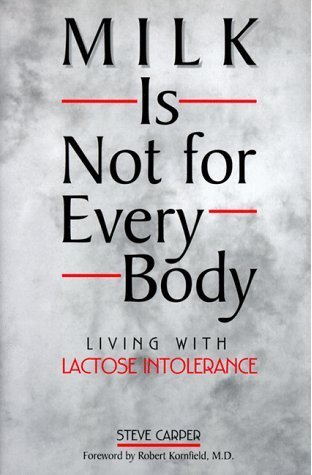
I wrote in my book, Milk Is Not for Every Body: Living with Lactose Intolerance, that colic was not caused by lactose intolerance.

Still true.

However, a press release ["ARA Content provides free, high quality feature articles to reporters, editors and print publishers. These features are copyright free and in a variety of categories coordinated to fit the editorial calendars of a typical newspaper."] disguised as a news story on EastBayRI.com quotes a doctor as saying that dairy allergies may be a cause.

"The medical community defines 'colic' as anytime a baby cries inconsolably for hours at a time for a minimum of three weeks," explains Dr. Steven Yannicelli, director of science and education for Nutricia North America. "A colicky baby will usually draw up her legs and appear restless and agitated. She is inconsolable, even though she isn't tired, hungry, hot, cold or upset for some other obvious reason."

Colic affects both boys and girls and usually begins when a baby is between three and six weeks old. Treatment of colic is specific to the cause, which may include overfeeding or emotional distress.

According to Dr. Yannicelli, colic can also be the result of a variety of allergic or gastrointestinal conditions. One possible cause is a milk protein allergy. Babies with this allergy cannot process the complex protein chains in milk-based baby formula and may be allergic to soy, too. According to the American Academy of Pediatrics, babies with a milk protein allergy should not be given soy-based formula either.

Babies with a milk protein allergy may also experience one or more other symptoms, such as diarrhea, vomiting, gas, skin rash, wheezing, low or no weight gain, or an overall failure to thrive.


Interesting, if true. Unfortunately, we're still at the stage of "some doctors believe..." rather than having hard data on this, as this page from infoparents.com states:
Colic is believed by some doctors to be another symptom of milk allergy. Colic is a condition in which an infant has frequent, long bouts of unexplained crying. But the connection between colic and milk allergy is uncertain. In fact, most babies with colic are not allergic to milk. But in a small percentage of cases, symptoms improve or even disappear when cow's milk is removed from a colicky baby's diet. If your doctor decides that your colicky child may benefit from switching formulas, you can be confident that your baby will still be getting proper nutrition from non-milk formulas. However, you should not remove cow's milk from your baby's diet - or your own diet if you're breastfeeding - unless your doctor has confirmed that the child does actually have a milk allergy.


And it's hard to know in which babies the cause is true a milk protein allergy and not something else.

Agostino Nocerino, MD, PhD, Chief of Pediatric Oncology, Department of Pediatrics, University of Udine, Italy, and Stefano Guandalini, MD, Director, University of Chicago Celiac Disease Program, Section Chief of Gastroenterology, Hepatology and Nutrition; Professor, Department of Pediatrics, University of Chicago Comer Children's Hospital, write on emedicine.com:
Studies including a selected population of infants report percentages of responses to the elimination diet to be as high as 89%. One blind study showed that 18% of infants with colic improved with soy formula, while 0% improved in another blind study. Moreover, in most of the responsive infants, the duration of the effect is not sustained, in spite of an ongoing elimination diet. In any case, true food protein intolerance can only be demonstrated in a small subgroup of infants with colic.


So the best that can be said is that if you can't find another cause for your baby's colic, consider the removal of milk from the diet. It may work, but it's not a cure-all.

Bookmark and Share

Tuesday, January 16, 2007

A naive domestic Burgundy without any breeding. [contains dairy]

Labels on commercial food products in the U.S. now have to state in plain language whether potential allergens like dairy, egg, or wheat are contained in the ingredients. This is mandated by the Food and Drug Administration (FDA).

Beer, wine, and liquor don't have to reveal their ingredients at all. Or much of anything else about them. For most of us most of the time, this is no big deal. Who thinks about alcoholic beverages containing dairy?

But they do. Milk stouts are made from lactose, as I wrote about in Lactose in Beer. And cream liquors, like Bailey's Irish Cream, Prestige Rom Cream Liqueur Essence, Amarula Cream Liqueur, and Danny DeVito's favorite, Gioia Luisa Cream Lemoncello, to name a few, all contain real cream.

Dairy can also be hidden in the manufacture of products, although it may or may not remain in the final product.

The problem for those of us with lactose intolerance, or dairy allergies, or vegans, or those keeping kosher, is that the FDA has no jurisdiction over wine or beer labeling. Who does? The fairly obscure Tax and Trade Bureau of the Alcohol and Tobacco unit under the U.S. Department of the Treasury.

So obscure is this arm of the government that when on July 26, 2006, they proposed a rule to require the same kind of allergen notification on beer, wine, and spirits, that few people outside the industry noticed.

The proposed rules aren't even all that easy to find from the www.ttb.gov site. However, I persevered and located a .pdf file here.

I've extracted from the bureaucratese the sections of most interest to those with dairy concerns:

* * * * *
(d) If a major food allergen as defined in § 4.32a is used in the production of a wine, there shall be included on a label affixed to the container a statement as required by that section.
* * * * *
3. Section 4.32a is revised to read as follows:
§ 4.32a Major food allergens.
(a) Definitions. For purposes of this section the following terms have the meanings indicated.
(1) Major food allergen. Major food allergen means any of the following:
(i) Milk, egg, fish (for example, bass, flounder, or cod), Crustacean shellfish (for example, crab, lobster, or shrimp), tree nuts (for example, almonds, pecans, or walnuts), wheat, peanuts, and soybeans; or
(ii) A food ingredient that contains protein derived from a food specified in paragraph (a)(1)(i) of this section,

(b) Labeling requirements. All major food allergens (defined in paragraph (a)(1) of this section) used in the production of a wine, including major food allergens used as fining or processing agents, must be declared on a label affixed to the container, except when subject to an approved petition for exemption described in § 4.32b. The major food allergens declaration must consist of the word ‘‘Contains’’ followed by a colon and the name of the food source source from which each major food allergen is derived (for example, ‘‘Contains: egg’’).


Similar rules are given for malt beverages [beer] and distilled spirits [liquor].

The comment period on the proposed rule has expired, but you can read the comments here.

The alcohol industry is against this, of course, because it provides yet another excuse for people to reject their products. A story by Nina M. Lentini from MediaPost's Marketing Daily sums up the opposition:
The San Francisco-based Wine Institute says ingredients such as egg whites, a milk protein called casein, and isinglass, a substance derived from fish guts, are often used to clarify the wine before bottling. These agents bond with yeast, bacteria and excess tannins, creating a larger molecule that sinks to the bottom of the barrel, leaving clear wine above. The agents are filtered out before bottling.

Gladys Horiuchi, communications manager at the Wine Institute, said wheat-based glues are sometimes used in sealing barrels. "Sometimes when they wash them out, wheat can get left behind." She also said there is "no definitive test" available to ascertain the presence of eggs, milk, wheat or fish in wine.

Russell Robbins, manager of the U.S. operations of Laffort Oenologie, a French wine supply company, told the Wine Institute that "there are no known instances of persons with fish allergies having any reaction to wine treated with isinglass, including winemakers that have known sensitivities to fish."

Some groups, like the Wine Institute, are asking the government to delay implementing the proposed rule until scientific testing improves. Others would like to see a global approach that is consistent.

Federal officials are looking to finalize a ruling by the end of the year.


For now, consumers should use the clues given in product names to stay away from dairy-containing alcoholic drinks. By next year, with any luck, a better system will be in place.

You can also write to your Representative or Senator and ask that they put pressure on the Tax and Trade Bureau so that this regulation doesn't get conveniently lost.

Bookmark and Share

Sunday, January 14, 2007

Soy Milk for Dairy Free Yorkshire Pudding

I'm always baffled about how substitutes work in recipes, and let's face it, most people - even cooks - haven't tried most substitutes in most recipes so they won't know either.

Gholam Rahman's food column at PalmBeachPost.com takes a stab at an unusual recipe request. I think she comes through okay, but I thought I'd repeat it here to see what people think.

Question: My niece is allergic to dairy products. Can I make Yorkshire pudding without milk, substituting maybe chicken broth? Thanks for your help. — Ann G., via e-mail

Answer: Originating in the Yorkshire region in the north of England, the pudding was originally made in the fat drippings from a roast beef and then served with gravy as part of the roast beef dinner. Mostly crust, it is raised by steam and eggs in a very hot oven, much like its American cousin, the popover.

Although milk plays a part in the puffing up of the batter, I don't think its role is critical. But there are better choices than chicken broth. I don't know if lactose intolerance is the cause of your niece's problem with dairy. If so, you can most likely use lactose-free milk, of which some brands are 100 percent free of lactose. These are real milk and will act just like milk although they are fat-free. You will have enough fat anyway in a Yorkshire pudding recipe. Otherwise, soy milk should also work in your recipe. Check with her doctor first, though.

When you tinker with a recipe, it is a good idea to follow the rest of the instructions carefully. Measure the ingredients accurately; preheat the oven to the desired degree, hot in this case and generally 425°; beat the batter smoothly and allow it to rest for a while, beating again to take any lumps out; and don't open the oven in the middle of baking or they likely will fall.

Bookmark and Share

Saturday, January 13, 2007

Nanotech Bandaids

I'm an sf writer, so it's rare that in the real world I run across something that sounds as if it came directly from the pages of a story, but this bit of nanotechnology - discovered by accident - is so nifty in its simplicity and usefulness that it just stunned me.

From MIT's Technology Review magazine:

In 2001, Rutledge Ellis-Behnke, PhD '03, a research scientist in the Department of Brain and Cognitive Sciences, was doing surgical research on hamster brains. He and his colleagues were using a liquid made of protein fragments known as peptides to encourage the regeneration of neural tissue, a prospective treatment for stroke.

...

Through a string of experiments at the University of Hong Kong, he discovered that when the liquid is applied to a surgical wound in a mouse or hamster, the peptides self-assemble into a nanoscale barrier that seals the wound. Once the wound heals, the nontoxic gel is broken down into molecules that cells use for tissue repair, Ellis-Behnke explains.

The researchers (including Kwok-Fai So, PhD '77, head of the Department of Anatomy at the University of Hong Kong) published the results in October 2006 in the journal Nanomedicine, noting that this was the first time nanotechnology had been used to halt bleeding in damaged blood vessels without clotting. "We have found a way to stop bleeding in less than 15 seconds that could revolutionize bleeding control," Ellis-Behnke says.

A zingier article is up at the Discover magazine website:
Researchers have stumbled upon a clear liquid that, in tests conducted so far, stops bleeding in about 15 seconds, faster and with fewer complications than other methods available today.

The researchers, from Massachusetts Institute of Technology and University of Hong Kong, have found a liquid that, according to one of the researchers, MIT's Rutledge Ellis-Behnke, can be applied "wherever there's an injury or a cut, and it ... stops bleeding right away without clotting."

Another member of the research team, Gerald Schneider, also of MIT, says its easy to administer and that, "You could put it in a tube and squeeze it out like toothpaste."

Ellis-Behnke adds when you wipe away the liquid, bleeding resumes, but if you reapply the liquid it stops.

The gel uses amino acids, the body's building blocks, to create nano-scale fibers that Ellis-Behnke says, "May be self assembling into a nano-patch." He describes the effect as similar to hair clogging a drain.


Very, very cool.

Bookmark and Share

Friday, January 12, 2007

Keeping Intestines Fit from the Inside Out

Jessica Peralta of the McClatchy Newspapers gives a solid list of tips for people with digestive difficulties in an article titled Stomach this Health and beauty advice for that troublesome gut. Well, to be honest, it's a somewhat overgeneralized list with something for almost every kind of intestinal ache from whatever source. But most of the tips are good advice for most everyone, so I'm reprinting a few here:

• Avoid a diet high in fat, caffeine and alcohol if you're having digestive problems -- these elements can trigger problems like abdominal pain, bloating and diarrhea. Dairy triggers diarrhea if you're lactose-intolerant.

• Drink plenty of water and practice regular physical activity to keep the gastrointestinal tract moving.

• Eat smaller and more frequent meals. Large meals cause regurgitation (aka heartburn) because of increased pressure in the stomach.

• Get 25-35 grams of fiber into your diet daily.

• Eat lean proteins throughout your day's meals to help control hunger. Nonfat string cheese, tofu, edamame, hardboiled eggs and shrimp cocktail are convenient protein snacks.

Bookmark and Share

Thursday, January 11, 2007

Are We Not Lactards? No, We Are Human Beings


The American Dialect Society does an annual Word of the Year competition, to recognize coinages and new usages.

They're way out on the cutting edge most years, finding words that few of us have ever encountered in real life. As you can read in the press release for this year (a .pdf file), the Word of the Year is something I, at least, have never encountered.

In its 17th annual words of the year vote, the American Dialect Society voted “plutoed” as the word of the year, in a run-off against climate canary. To pluto is to demote or devalue someone or something, as happened to the former planet Pluto when the General Assembly of the International Astronomical Union decided Pluto no longer met its definition of a planet.


Yeah, that's going to catch on real quick. Astronomical puns are a big part of my life.

Wait, it gets worse. Their winner for most creative? Lactard.

Lactard? Yes, lactard. A person who is lactose intolerant. Oooh, pretty.

Um, note to the morons at the ADS: lactard is an insult. Check out one of the definitions at Urban Dictionary.
A derogatory term for one who is lactose intolerant combining the word retard with 'lactose'.

Person 1: "Uh, why is that girl drinking soymilk?"
Person 2: "Because she's a LACTARD".
Person 1: "HA HA!"


Ha and ha.

Here's a clue, folks. Anything that starts with the word "retard" isn't bestowing a benediction.

Not that it really matters much. Lactard is only slightly more likely to make it into the dictionary than "plutoed."

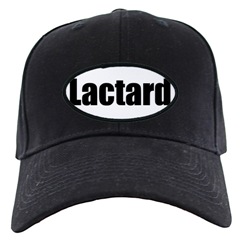
But if you think I don't have a sense of self-deprecating humor, why don't you try wearing the t-shirt. Sold by Kristen of Kristen's Lactose Intolerant Website, the page offers shirts, aprons, mugs, caps, and stickers, all proudly bearing "lactard."

To be honest, I thought her site was defunct since it hasn't been updated apparently in years, but the lactard goods page, hosted elsewhere, seems to be alive.

Lift your head high and proclaim to the world that you're a lactard.

Just don't let me catch you doing so.

Bookmark and Share

Wednesday, January 10, 2007

Fermentation Technique May Cut Whey Allergies

Allergies are sparking some of the most interesting and creative food research. The need and desire to reduce allergic reactions, especially in children, has inspired a variety of techniques. Some promising - Desensitizing Food Allergies Possible in New Study - and some far more distant at best - Cure for Allergies? Don't Hold Your Breath.

The latest news is somewhere in between: extremely promising but probably nothing that will appear in your local supermarket anytime soon. Think of it as a well-hit double as opposed to swinging for the fences at the home run of eliminating allergies.

The study appeared in the journal Innovative Food Science & Emerging Technologies, Volume 7, Issue 3 , Pages 233-238. "Screening for lactic acid bacteria with potential to reduce antigenic response of beta-lactoglobulin in bovine skim milk and sweet whey," by N. Kleber, U. Weyrich, and J. Hinrichs.

I'm taking the news from an article posted at FoodNavigator.com.

Fermentation of dairy with a mix of lactic acid bacteria and a Streptococcus strain could selectively reduce the protein responsible for cows milk allergy, researchers have reported.

Researchers at Germany's University of Hohenheim have reported that fermentation of skim milk and sweet whey with a one-to-one mixture of the bacteria could reduce the quantity of beta-lactoglobulin, the main allergen in cows milk, by as much as 90 per cent.

The research may also have implications for the wider food industry since whey and whey-derived ingredients are extensively used in a range of food products.

...

"In more than 80 per cent of all cases, the whey protein beta-lactoglobulin (beta-lg) is the main elicitor of milk allergies for children and infants. Beta-lg is the major whey protein in milk and milk products and it is of particular interest because it is the sole whey protein fraction present in cow's milk which is not in human milk," explained lead author Nicole Kleber.

...

However, the researchers stressed that only the antigenicity of beta-lg was tested while the actual allergenicity was not.


Yep, you guessed it. More studies will be needed to test whether allergic reactions in people are truly reduced or whether this is just a lab-only success.

Bookmark and Share

Tuesday, January 09, 2007

Cyndi Lauper Sings: "Lactose Intolerant"

I was over at YouTube and it suddenly occurred to me to wonder what would happen if I plugged "lactose" into their search engine.

Result? 89 hits.

I haven't watched all of them, but I can't resist sharing this clip right away. It's Cyndi Lauper on Letterman, Sept. 15th, 1995. You know, back when he was actually funny.


I'll keep checking to see if any others are as good. If you know of any, let me know.

Bookmark and Share

Monday, January 08, 2007

Stop Smoking. Now.

Calvin Trillan has been publishing wonderful wry, witty pieces on all subjects, especially about food, for over 30 years. His new book, About Alice, is a tribute to his late wife, earlier immortalized in books such as Travels with Alice.

The review by Peter Stevenson in the January 14, 2007 New York Times Book Review [subscribers get copies early], has these lines:

In 1976 Alice -- who's never smoked but grew up with a chain-smoking mother and cigar-smoking father -- coughed up a spot of blood. Ten days later she had a lobe of her left left removed. A doctor told Trillan there was a 10 percent chance she'd survive beyond a year or two.

She did survive. But she died in 2001 waiting for a heart transplant, her heart having been weakened by radiation during her battle with the cancer.

What more does it take? Even if there weren't mountains of evidence that second had smoke were deadly, shouldn't the tiniest possibility that it might kill your children be enough to get you to quit?

Stop smoking. Now. For everybody's sake.

Bookmark and Share

New Source of Stem Calls? A Good Thing?

Over at Health24.com they report that:

Scientists has reported the discovery of a new source of human stem cells that have the capability to develop into many different types of cells, including muscle, bone, fat, blood vessel, nerve and liver cells.

These stem cells, found in amniotic fluid, could one day lead to a readily available supply of stem cells that don't come with the ethical problems surrounding embryonic stem cells.

Are the people who have been screaming that all the benefits ever needed can be garnered from adult stem cells going to badmouth this discovery too?

Just wondering.

Bookmark and Share

FTC Attacks Diet Pill Makers

What a great week it's been for the forces of rationality. The same day that the BBC published a stinging article on idiot celebrity pronouncements on health, Celebrities Attack Science, the FTC did some attacking of its own.

Science Daily has the text of the Federal Trade Commission (FTC) press release, which starts with these wonderful words:

The FTC has filed complaints in four separate cases alleging that weight-loss and weight-control claims were not supported by competent and reliable scientific evidence. Marketers of the four products --Xenadrine EFX, CortiSlim, TrimSpa, and One-A-Day WeightSmart -- have settled with the FTC, surrendered cash and other assets worth at least $25 million, and agreed to limit their future advertising claims.


FTC Chairman Deborah Majoras said that "The marketers are required to back up the claims with the science, and if they can’t do that, they can’t make the claim." Unfortunately, the pills themselves won't be banned or taken off the market, but at least the worst of the deceptive ads will have to change.

And in a "they're all crooks" sidenote, remember that no diet pill is worth a damn. WCNC.com, from Charlotte, NC, has a quote from Tom Bartholomy of their local Better Business Bureau.
"The top three [consumer complaints] that we are seeing right now with the most inquiries and most complaints about are things relative to hoodia, ephedra, and anatrim."

How awful are they?
Hoodia Miracle Diet gets a grade of "unsatisfactory" from the BBB - and PureHoodia, Inc. gets an "F" - which means the BBB "questions the company's reliability" and that "especially serious allegations" are on file.

Diet and exercise will help you lose weight. Forget the "magic pill." The magic they work best is cleaning out your wallet, not your system.

Bookmark and Share

Sunday, January 07, 2007

Whole-Milk Drinkers Gain Less Weight

Only a few days after I pounded the idiocy of a quote from Heather Mills ex-McCartney that "those children who drink the most milk gain the most weight," I find a medical study that comes to a very different conclusion. Irony abounds.

The study, from the December 2006 American Journal of Clinical Nutrition and reported by Reuters, doesn't so much refute Mills' comment as add another dimension to the overall subject: the relationship between milk-drinking and weight gain.

The findings are based on data from 19,352 women ages 40 to 55 who were surveyed about their diets, weight and other health factors at the study's outset and again 9 years later.

Women who said they had whole milk or cheese at least once a day throughout the study period were less likely to report a significant weight gain -- defined as 2 pounds or more per year.

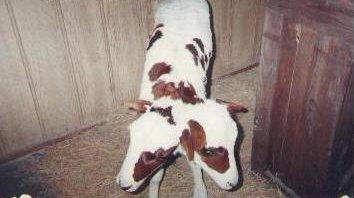
Even though this was a very large longitudinal study, the factors involved are so complex that the rest of the article is a series of caveats, sort of like a two-headed cow.


For one thing, only whole milk, and not low-fat milk, seemed to offer protection against weight gain. For another, the benefit was seen only among women who were normal-weight at the start of the study.

It's always possible that the associations between dairy intake and weight gain do not reflect a direct action of dairy foods at all, according to Dr. Magdalena Rosell, a researcher at the Karolinska Institute in Stockholm and the study's lead author.

Eating habits can be seen as a marker of overall lifestyle, and women who favored whole milk might have had other habits that aided their weight control, Rosell told Reuters Health.

It's also possible that women who had already been gaining weight opted to drink low-fat milk -- making the milk a "marker," but not a cause, of weight gain, according to Rosell.

And not even Dr. Rosell thinks that women should go back to drinking whole milk:
At this point, there's no reason, Rosell said, for people to eschew the general advice to choose low-fat dairy products, which are lower in artery-clogging saturated fats.

Not the neat, clear-cut results one would hope for, are they? As I've said many times before, and unfortunately will have to say many times again, teasing out the influences that any one food or nutrient play in our overall eating habits is next to impossible, even for the best-run studies. No one study should ever be the cause of your changing your life habits. And never get your medical news from a newspaper headline.

Bookmark and Share

Thursday, January 04, 2007

Soy Milk to Lower Cholesterol?

General Mills, the food giant, and Medialink, a PR service, are joining together to push the idea of substituting soy milk for cow's milk. The goal is to lower cholesterol, since plant sources of protein typically contain less fat than animal sources.

The logic is somewhat dubious, since skim milk has gained popularly as whole milk sales have plummeted, and most soy milks are not fat free. Still, those of us with lactose intolerance or dairy allergies would do well to avoid large quantities of liquid milk. While traveling over the last week (that's why no entries - I couldn't make a connection through my in-law's computers) I had a peppermint hot chocolate with soy milk at a Starbucks. Very good.

There's a propaganda video, excuse me, a promotional video at http://media.medialink.com/WebNR.aspx?story=32908. The video features representatives from 8th Continent Soymilk, not the most objective of sources. I also had trouble with the audio for unexplained reasons.

The 8th Continent website does give a long list of useful tips for substituting soymilk for cow's milk.

8th Continent Original Soymilk

    Replace dairy milk for:

    • Scratch or biscuit mix biscuits

    • Potato casseroles

    • Corn bread recipes or mix

    • Mashed potatoes-instant or homemade

    • Cream sauces and soups

    • Condensed soups (tomato is especially tasty!)

    • Macaroni and cheese (mixes or from scratch)

    • Scrambled eggs or baked egg dish

    • Creamy salad dressings or dips


8th Continent Vanilla Soymilk

    Replace dairy milk or water for:

    • French toast

    • Pancakes and waffles

    • Shortcake biscuits (think summertime strawberry shortcake!)

    • Chai, lattes and other milk-based coffee drinks

    • Homemade muffins, scones and other quick breads

    • Convenience baking mixes - cheesecakes, cookies, bars, muffins ...

    • Homemade cookies, bars, quick breads and cakes


A word of warning they won't give you: not all soy milk is alike. There are dozens of soy milk types, varieties, and brands, all different. You can find low fat and high fat, low calcium and high calcium, sweetened and unsweetened, and every other possible distinction. You need to find the soy milk that is best for you, with the right health benefits and the right taste.

One more warning: There are anti-soy nuts, just as there are anti-milk nuts. No good evidence exists yet to show that soy is dangerous to the average person, although some people can have soy allergies in addition to or instead of milk allergies. Enjoy your soy, and don't worry.

Bookmark and Share

Wednesday, January 03, 2007

Celebrities Attack Science!

But the BBC counterattacks with sense!

Look, I have nothing against celebrities speaking out on any subject they wish, including politics, religion, and social issues. Yeah, their words get more coverage than the rest of us but that's your fault, you, and you, and you, and all of you out there whose fawning obsession with celebrities make them so quotable.

One big exception. We're all hurt when celebs speak out on medicine, or what they think might be medicine. You don't get to have equal opinions on medical subjects with, you know, actual doctors and other experts.

The BBC took some actual quotes from some British celebrities and paired them with responses from experts. One is of course on milk, the bane of every science idiot.

HEATHER MILLS MCCARTNEY, FORMER MODEL

"...every day there's a new report warning that obesity levels in children are out of control... The fact that those children who drink the most milk gain the most weight should cause alarm bells to be ringing everywhere. It isn't and milk is still being pushed as essential for children."

Dr Philip Coan, physiologist, University of Cambridge: "It is not true to say that children who gain the most weight are doing so because of milk consumption.

"A US study looked at milk consumption in two to five-year-olds over a three-year period.

"It found no link between increases in child weight and increases in drink consumption.

"In relation to milk, child weight was not linked to whether the children drank full-fat, semi-skimmed or skimmed milk."


Kids who have dairy allergies shouldn't drink milk, true. But other children, including those who are lactose intolerant, will find that milk is a good source of nutrients in a tasty package. Milk is something you can get most kids to drink. And it's far, far better for them than soda. Better than juices. Better than beer. (What? Who's claiming otherwise? A PETA campaign did once. It didn't last long.)

Kids, drink your milk. And ignore the nice lady who does such good work against landmines but doesn't know what she's talking about here.

Bookmark and Share

Monday, December 25, 2006

Post Punk Vegans

I wrote about the new cookbook Vegan Cupcakes Take Over the World back on November 29.

I didn't realize I was only giving you half the story.

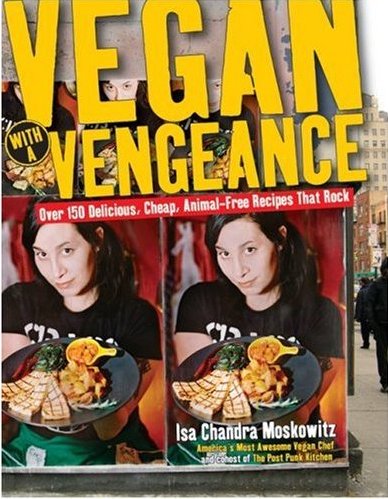
Isa Chandra Moskowitz and Terry Hope Romero were the co-hosts of a public access vegan cooking show, The Post Punk Kitchen. Well, four episodes, at least, which are still available via Google video.


And the Vegan Cupcake book is a sequel to Isa's cookbook from last year, Vegan with a Vengeance: Over 150 Delicious, Cheap, Animal-Free Recipes That Rock.

Want more? Isa and Terry and the rest of the Post Punk Kitchen crew have a website, theppk.com with recipes, forums, links to this and that, and the usual good stuff that comes with the freedom of being able to put everything out for the public.

Vegan with a Vengeance is available through their website, of course, or through my Milk-Free Bookstore on the Vegan Cookbooks page.

Bookmark and Share

Sunday, December 24, 2006

Dairy-Free Recipes from Kosher Cookbooks

Sure I know it's Christmas Eve. I'm just feeling perverse. It's my revenge for 24/7 Christmas carols starting November 1.

In What Ever Happened to Mom's Apple Cake? Rachel Silverman talks about the findings of food historian Dr. Carol Harris Shapiro who notes that Jews in America assimilated their food along with other cultural touchstones.

Shapiro also said that the recent wave of health consciousness put Jewish food on the back-burner, so to speak. Between dishes laden with fat (noodle kugel), sodium (corned-beef sandwiches) and sugar (apple cake), the professor confirmed that "pretty much the entire Jewish Ashkenazi cookbook" has been "wiped out."

Even though Shapiro said that "food is one of the very last things to leave an ethnic group," she described contemporary Jewish cuisine as steeped "in a tremendous time of flux."

Lecture attendee Herman Jacobowitz agreed, citing his own personal ambivalence about the amalgamation process.

While he said that he enjoys the Israeli-style tapas, pungent spices and soy ice-cream his daughter serves on Shabbat, he admitted to a certain nostalgia for recipes from his youth.


So let's explore some of those new-fangled Jewish foods, with dairy-free recipes that are good for those who are lactose intolerant, dairy allergic, or vegans as well.

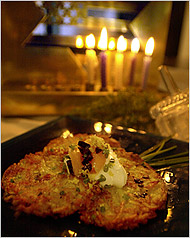
Leave it to the New York Times to feature the Ultimate Potato Pancake recipe, adapted from Daniel Boulud's The New American Cooking.


Nancy Coale Zippe wrote 'Where There's Food …', an article about the new cookbook Where There's Food ... There's a Celebration.

Recipes on that page include:
  • "A Great Gift of Rice" mix
  • Salmon with Mustard Crumb Crust
  • Potato Latkes


Then there's Roseanne Gold, author of Kids Cook 1-2-3 who shares her recipes on Celebrate Hanukkah with latkes.

  • 1-2-3 Latkes
  • 1-2-3 Apple-Cranberry Sauce
  • 1-2-3 Apple-Cranberry Salsa


Finally, there's Doris Reynolds who wrote Let’s Talk Food: Main ingredient for latkes not just potatoes. She has the most old fashioned kind of recipe in, appropriately:

  • Molly Goldberg’s old fashioned potato latkes, from Molly Goldberg's cookbook Molly Goldberg Cooks.
  • She moderns it up with Zucchini Parmesan latkes. This recipe contains a small amount of cheese as an ingredient, but the cheese is absolutely not necessary to the result and can be safely left out.

Bookmark and Share

Thursday, December 21, 2006

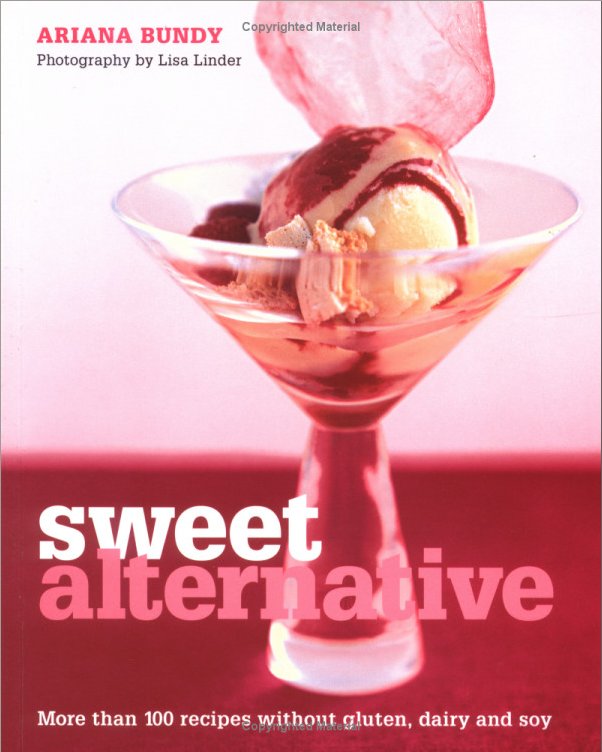
Sweet Alternative: A Cookbook for Us


Ariana Bundy, who now lives in Paris, was once the Head Pastry Chef at the L.A. Mondrian Hotel and also trained the dessert team in New York's Morgan's Hotel. I guess she can do a mean dessert.

That's good for those of us who are lactose intolerant, gluten intolerant, or have dairy allergies, because her new cookbook is Sweet Alternative: More Than 100 Recipes Without Gluten, Dairy and Soy.

The description says:

Sweet Alternative has substitute choices for those who must give up dairy, gluten or soy, without compromising on taste. Using years of research and recipe testing, Ariana Bundy provides 100 mouth-watering cookies, muffins, cakes, ice creams and other irresistible treats all made without dairy, gluten or soy.

Using ingredients such as nut milks, candied peels, fresh fruit purées, and quality chocolate, the author shows how to make vanilla ice cream, chocolate muffins enriched with quinoa, and luscious crème patissiere -- all without gluten.

These recipes are simple and the ingredients are widely available. More than 150 photographs whet the appetite for such dishes as:

  • Maple-sweetened Corn Muffins
  • French Macaroons, and
  • Silky Smooth Pumpkin Pie.


You can find the book in my Milk-Free Bookstore on the Kids, Parenting and Special Diets page along with other dessert cookbooks that feature dairy or wheat-free recipes.

Bookmark and Share

Wednesday, December 20, 2006

Reindeer Milk and Cookies for Santa?


Hold Rudolph down, elves, she's kicking and we need the milk!

Reindeer milk? Yes, kiddies, it's that time of year when the press has run out of Christmas themes to mine and starts digging deep into the drawer of desperation for ideas.

Sure, reindeer milk is comparatively low-lactose, as you can see at my website on the Lactose Zoo page. But only a Finn who grows up in the midst of them would bother. They rank just above a pig in difficulty of milkability.

Anyway, FoodNavigator.com is this year's winner of the Farthest Reach Award, given to a news site that has gone the longest and silliest way to shoehorn in a theme, for its article by Stephen Daniells, "Reindeer milk - not on Santa's list this year."

Among the highlights:

It is hard to imagine large scale milking of these animals, not only since the process is labour intensive but also because the output is poor. According to the FAO, reindeer milk yields are extremely low. Couple this to the fact that it apparently takes two people to milk the beasts - one to do the milking and the other to hold the horns it is no wonder that the milk has never gone mainstream.

...

The milk does have a distinctive nutritional profile, with a fat content of 22 per cent, a whopping six times as much as cow's milk. Donkey milk contains less than one per cent fat.

Additionally, reindeer milk is poor in lactose, containing only about 2.4 per cent - equivalent to about a one-third the lactose content of human milk (7 per cent) and half that of cow's milk (4-5 per cent), according to Fundamentals of Dairy Chemistry (B. Webb, A. Johnson, AVI Publishing, 1965).

On Donner, Blitzen, and Elsie!

Bookmark and Share

Monday, December 18, 2006

Curious, but Lactose, Casein and Gluten-Free Cookies

Curious Cookie, the "all natural gourmet" cookies, makes a line of cookies that are free of everything except, hopefully, taste.


Their "Gluten Free Gourmet Cookies" are more than just that:

A Blend of the Finest All Natural Gluten Free Flours are combined with a Gluten Substitute to create a truly outstanding Gluten Free Line of Cookies. These cookies are lactose/casein free and void of any hydrogenated oils/fats or Trans Fats.


And they come in five varieties:
  • Chocolate Chip
  • Lemon Chocolate Chip
  • Chocolate Chocolate Chip
  • Ginger Cranberry
  • Assorted Cookies


Contact them:
By Email: customerservice@curiouscookie.com

By Phone: Toll free 877-YUMMY-2-U (986-6928)
Local 973-616-8500

By Mail: Curious Cookie
719 Hamburg Tpke
Pompton Lakes, NJ 07442

Or just go to the website.

Flat rate shipping starts at $8.75.

Bookmark and Share

Sunday, December 17, 2006

Your Cats May Be Mutants Too

Everybody knows that cats love milk. And everybody knows that you shouldn't give milk to cats because they're lactose intolerant just like humans. Right?

Maybe not.

An article by Regina and Douglas Haggo in The Hamilton Spectator drops an odd little tidbit in the middle of a comment on the much-talked about study that says Milk-Drinking Crucial to Human Evolution.

The availability of cows' milk turned a useless mutation into an invaluable one. Natural selection would favour people with the lactose-digesting gene switched on permanently, because they could profit from the calories, vitamins and minerals in milk.

Many European cat breeds show a similar mutation that allows them to enjoy milk as adults, while oriental breeds, like most Asian humans, are lactose-intolerant.

Is this true? Any cat-fanciers out there know the facts?

Bookmark and Share

Saturday, December 16, 2006

Stopping Dairy Doesn't Cut Asthma Symptoms

I've been hearing anecdotes for years from those in the anti-milk community that taking children off of dairy problems relieves their asthma symptoms.

While it's impossible to say for sure for any individual whether that may be the case, a major study has found no such correlation.

The International Study on Allergy and Asthma in Childhood 2 (ISAAC-2) looked at the consumption of fruits, vegetables, dairy products, whole grain products, and fish in relation to asthma in 598 Dutch children between the ages of 8 and 13 years. Findings were published in the medical journal Thorax.

According to a story from the Reuters Health news syndicate, Whole grains and fish may protect against asthma:

Parents completed food questionnaires, which were used to estimate the kids' dietary intakes. Wheezing and asthma were also determined with questionnaires, as well as from medical tests.

No clear associations were observed between asthma or wheezing and intake of citrus fruits, vegetables, and dairy products, but there was a link with consumption of fish and whole grain products.

"The crude prevalence of current wheeze was observed to be 19.4% in children with a low intake of both foods compared with 4.2% in children with a high intake of both foods," Smit's team [Dr. H. A. Smit, of the National Institute of Public Health and the Environment, in Bilthoven, the Netherlands, and colleagues] reports. "For current asthma the crude prevalences were 16.7% and 2.8%, respectively."

After adjustments, whole grains and fish were linked to a reduction of 54 percent and 66 percent, respectively, in the likelihood of having asthma, and similar reductions of 45 percent and 56 percent for wheezing.

Further studies will look at the reasons why whole grains and fish may decrease the likelihood of these symptoms.

However, dairy products appeared to have no effect on asthma symptoms.

Bookmark and Share

Friday, December 15, 2006

Patricia Wheway: Creator of "Free From" Foods

I've written about "free from" foods before. Free-From Foods to be Less Fickle in UK, "Free From" Foods Grow in Sales, and More UK Free-From Foods Honoured.

"Free from" foods are free of ingredients like milk or wheat that can trigger allergies, lactose intolerance, celiac disease or other eating disorders. The term seems to be uniquely U.K. At least, it's not one I've seen in the U.S. and I don't remember coming across it in articles about other countries.

Another thing I didn't know was the origin of the term. It came in a dream.

But maybe I should start at the beginning.

As Simon Crompton writes for the TimesOnline, A one-woman food revolution, the free from campaign is due entirely to one woman: Patricia Wheway.

Her son, George, suffered from a long series of problems. More through trial and experimentation than doctor's awareness, she found that removing various allergens from his diet helped remove his symptoms. But finding foods that were made without dairy, wheat, or certain additives were a challenge. As I've written in those previous posts, the U.K. lagged years behind the U.S. in developing a true alternative foods market.

When nobody else has stepped up, sometimes you just have to do things yourself. When I first learned in 1978 that I was LI, only one book existed that was of any help: Isobel Sainsbury's The Milk-Free and Milk-Free Egg-Free Cookbook. She had written it because her own son - born in 1954! - was allergic to dairy and eggs and no cookbooks could be found that didn't load up the recipes with milk and eggs and she had to learn how to devise substitute recipes for herself.

I wrote my first book on LI, No Milk Today: How to Live with Lactose Intolerance, because there weren't any books on LI and I wanted to share with others the years of research I put in on my own.

Wheway's problem was slightly different: she couldn't find the products she wanted. So she wrote to the head of the largest supermarket chain in the U.K. and asked to take over. And they agreed.

Wheway trudged around every supermarket and every health store near her Surrey home, trying to find something that was safe and edible, but in vain. “I was baking gluten-free bread for him every day and preparing all his food myself,” she says. Angry at the food industry, disillusioned and worn down by George’s obsessional behaviour (he would switch lights on and off for hours), she wanted to change things. In 2001 she decided she was the person who would make the food industry change. She wrote to Tesco’s chief executive, Sir Terry Leahy, with a plan for the sorts of allergy foods that any self-respecting supermarket should have on its shelves. She told them all about herself — her background in retail; her experiences with George — set out a strategy, and offered to develop the range herself.

Amazingly, Tesco said yes. Sir Terry wrote and asked her to come to see them, and then gave her a job. It ended up with Wheway introducing Tesco’s Free From range in 2002, and kick-starting a supermarket revolution with all the other leading stores following suit. She is now brand manager at Tesco, not just for Free From but also the additive-free Tesco Kids range, launched last February, and the Fairtrade range. It makes her one of the most influential voices in the UK’s biggest food store.


She gave the line of foods the name "free from" because it really did come to her in a dream. Still a great name, though.
and the response was amazing, she says. Market research indicated that customers thought it was one of the main areas where “Every little helps”, as the Tesco slogan goes. The main purchasers, she says, are people with coeliac disease (an inability to digest gluten) or intolerance to wheat or gluten. Tesco sells more than £30 million worth of the range annually and expanded it this year because of customer demand. Wheway believes that people with food allergies and intolerances are now much better catered for than the days when she was tearing out her hair.


Two other major U.K. chains, Sainsbury's (any relation to Isobel? I don't honestly know) and Morrisons, have also introduced "free from" lines.

A happy ending? You bet.
George, now 10, is happily settled at a small school for children with moderate learning disabilities, and is free from seizures, diarrhoea and hyperactivity. The family lives a short drive from Tesco’s headquarters in Cheshunt, Hertfordshire, and Wheway has been allowed to work part-time so that she can be with George after school. This year she won an Allergy Magazine award.


Congratulations from me as well.

Bookmark and Share

Tuesday, December 12, 2006

Milk Mutation "Strongest Signal of Selection"

More info is coming in on the report highlighted in Monday's post, Milk-Drinking Crucial to Human Evolution.

Scientific American has weighed in with its own article, African Adaptation to Digesting Milk Is "Strongest Signal of Selection Ever", by Nikhil Swaminathan.

According to University of Maryland biologist Sarah Tishkoff, the lead author of a study appearing in today's Nature Genetics, the mutation allowing them to "get milk" arose so quickly and was so advantageous that "it is basically the strongest signal of selection ever observed in any genome, in any study, in any population in the world."

...

Tishkoff's team determined the date range when the mutation likely occurred: 3,000 to 7,000 years ago, which matches up well with the archaeological record that places pastoralization coming to East Africa about 5,000 years ago. The European trait dates back about 9,000 years.

Tishkoff believes that because she found so many markers associated with lactose tolerance in the sequencing of her 109 subjects, evolution clearly develops multiple solutions when there is a strong selective force. "There are some populations that can digest milk, and they don't have any of these mutations," she says. "There are more out there."


The abstract for the article can be found on the Nature Genetics website, but it won't mean anything except to specialists.

An even fuller version of the report is scheduled for the December 15, 2006 issue of Science, the premier science journal in the U.S.

Bookmark and Share

Sunday, December 10, 2006

Milk-Drinking Crucial to Human Evolution


In my book, Milk Is Not for Every Body, I provided an explanation for lactose persistance, that strange condition which allows adults to drink milk without symptoms. Here's an excerpt from the book:

The combination of the convenient presence of milk from domesticated animals, the nutritional advantage that milk can offer and the genetic dominance of the LP gene form the basis for the current scientific consensus that natural selection pressures account for the astoundingly high percentages of LP in certain corners of the world today. Once set into motion, the spread of milk-drinking appears to be inevitable, having happened at least twice in different ways in different parts of the world.

All that is necessary is that the following three conditions (set out by John D. Johnson, Norman Kretchmer and Frederick J. Simoons in "Lactose Malabsorption: Its Biology and History," Advances in Pediatrics, 1974:21:197-237) be in place. LP is almost certain to appear whenever a cohesive group of people:

    1) Have a plentiful milk supply;

    2) Do not process their milk into products that are low in lactose; and

    3) Cannot readily obtain from other available foods essential nutrients that milk does provide.


The situation that would clearly create the greatest selection pressure is the one in which a group has literally nothing else to eat other than milk.

Impossible as it might seem, there are many such groups, all of them tribal nomads on the fringes of the Sahara desert. Take the Beja, who live in the Sudan between the Nile and the Red Sea. As recently as 5,000 years ago, northern Africa had a much wetter climate. When the rains dried up, so did the land, leading to a spread of the desert into traditional nomadic pastoral lands. Agriculture became impossible in this desert setting. Only animals could eat the few plants that naturally grew and no other food sources were available (condition 3). Yet the Beja survive as long as their animals do. During the dry season that may last as long as nine months they live almost entirely on the milk of their camels and goats, up to 3 quarts per adult per day (condition 1). Milk processing and storage in forms that are low in lactose is impossible given the desert temperatures and the nomadic Beja lifestyle. All the milk must be drunk fresh (condition 2). As the Beja clearly satisfy all three conditions, they must have faced enormous selection pressures over the centuries in favor of those tribal members who could drink milk without getting sick. Today, over 80% of the Beja test as LP.

Nor are they alone. Other nomadic desert peoples who have high frequencies of LP include the Bedouins in Arabia and the Libyan desert, Kabbabish in the western Sudan, Tuareg in the central Sahara, and the Fulbe (Peulh) in the northern Sahel. (Whether each is an independent example of LP evolution or whether intertribal mixing of genes occurred is not clear.) Because their particular tribal cultures and unique histories have determined their powerful dependence on milk, this explanation for their LP is known as the "culture historical hypothesis."


None of this exactly qualifies as breaking news. My sources for this are now over 30 years old.

However, everything old is new again, especially when people look at it in a new way.

The genetic mutation which created the lactose tolerance of these African tribes has just now been found, according to Nicholas Wade, in an article in The New York Times, Study Detects Recent Instance of Human Evolution. (May need free registration.)

Intriguingly, the exact mutations for these tribes differ from the one shared by most Europeans. That means it came from a separate set of mutations fostered by separate natural selection, something that is called "convergent evolution." This is one of the first examples of convergent evolution documented at the genetic level.

Wade wrote:
Genetic evidence shows that the mutations conferred an enormous selective advantage on their owners, enabling them to leave almost 10 times as many descendants as people without them. The mutations have created “one of the strongest genetic signatures of natural selection yet reported in humans,” the researchers write.


And it shows the importance to human survival of the domestication of animals and the use of all available natural substances as food.

Far from being unnatural to drink cow's milk, as the anti-milk crowd's propaganda has it, the genius of humans being omnivores appears to be something absolutely basic to humanity's survival.

Try that out at your next PETA meeting.

Bookmark and Share

Friday, December 08, 2006

Dairy Free Made Easy

Alisa Fleming of GoDairyFree.org sent me an announcement about her new book.

December 7, 2006 - Alisa Marie Fleming of GoDairyFree.org is proud to announce her new book Dairy Free Made Easy: Thousands of Foods, Hundreds of Tips, and Dozens of Recipes for Non-Dairy Living.

Over 10 million Americans follow a dairy free diet, and millions more are striving to cut back. In a world rich with cream and cheese this can seem a difficult feat. Luckily this unique new resource has emerged. Though accurate, the title of this book may be an understatement. It is loaded with non-dairy foods, over 2000 entries in fact, and it does contain countless tips for cooking, baking, dining out, and grocery shopping. As well, there are several starter recipes for desserts, entrees, cheeses, milk alternatives, and other dairy substitutes. Yet, there is even more to this elaborate food guide.

Dairy Free Made Easy covers ‘understanding dairy milk’ to ensure readers are aware of the various types of milk (organic, goat, etc.) and what dietary needs they may have, since milk has become such a big nutrient source in the American diet. There is also a ‘strong bones’ guide with calcium resources and health information. Of course, the book would not be complete without discussions of milk allergies (for infants, children, and adults), lactose intolerance, weight loss, the vegan diet, chronic disease prevention, soy, and dairy food addiction.

The product lists within this book could stand alone in their own guide. Every item listed is free of dairy ingredients, hydrogenated oils (trans fats), and high fructose corn syrup. For those with additional diet concerns, the author has gone to the trouble of identifying which products are also vegan, kosher certified, manufactured on dairy free dedicated equipment, and free of gluten or soy ingredients. Plus, a manufacturer’s contact list (roughly 500 companies) offers website addresses and phone numbers for direct consumer inquiries.

To further the practicality, Dairy Free Made Easy is packaged in a spiral bound format for convenient in store and kitchen usage. The portable size and ability to flip right to the ‘dairy ingredients’ reference page is a savior while grocery shopping.

To up the ante, each book purchased directly from the publisher, Go Dairy Free, will include several coupons and discounts worth over $40 in value. As a special introduction to dairy free living, coupons are enclosed for non-dairy ice cream soy yogurt, dip, vegan cheese, baking mix, granola, cookies, soymilk, frozen entrees, and more!

Due to the inclusion of these money-saving offers, quantities are limited. Fortunately, Dairy Free Made Easy can be purchased directly from www.GoDairyFree.org should you not find it in your local store.


Her order form is hard to duplicate on a blog, so just go directly to her book page to order one.

I did.

(And why doesn't Google's auto-fill work on a Google Checkout page? Can anybody explain that?)

Bookmark and Share

Thursday, December 07, 2006

I Win medGadget's Short Story Contest

This isn't about LI, or dairy, or allergies, or any of the things I usually write about, but it's my blog so what the hey.

And it is medically-related. Tangentially. Sorta.

Anyway, a site called medGadget.com held a "sci-fi" writing contest. As the site name indicates, it's a news site, kind of a blog, that concentrates on medical hardware the way I scour the world for info on dairy-free products. Their contest was to work up a short-story about medicine in the future, gadget-related or not.

OK, I'm normally a purist about calling sf sf, and not "sci-fi," but I can't change the world. Besides: I had an idea. I expanded it into a story and popped it into an email right at deadline.

And I won. "Just brilliant," they called it. Who am I to disagree?

You can read the story, the story behind the story, and the runner-up stories here.

The prize. Um, well, it's a Thinklabs ds32a Stethoscope with Electromagnetic Diaphragm. The link is a shout out to the company that donated it to the contest. Don't worry, guys. I'll find it a good home.

Bookmark and Share

Wednesday, December 06, 2006

Don't let Flatulence Spoil Yours or 99 Others Travel Plans

It's our horrible little not-so-secret that lactose intolerance can produce some of the most vile gas to pass from the human body.

As a public service I'm reprinting this press release. Then let's not talk about it. OK?

Mililani, Hawaii (PRWEB) December 6, 2006 -- A Dallas women, on American Airlines flight #1053 bound for Dallas caused the aircraft to have an emergency landing in Nashville, Tennessee due to her episode of smelly flatulence. This individual suffered from a medical condition that caused excessive intestinal gas. She tried to cover up the odor by lighting matches and some passengers thought it was fumes from a bomb. If she had known about the Flatulence Deodorizer she would not have disrupted the travel of 99 passengers.

Brian Conant, President of Flat-D Innovations, Inc. is the Inventor of the patented product called "The Flatulence Deodorizer". The Flatulence Deodorizer is Doctor Recommended for a" better quality of life" and has been designed to assist people that suffer from dietary, medication side effects and medical conditions. Conant says..."they've had great success helping people that have disorders such as Celiac's Disease, Crohn's, Colitis, Diabetes, HIV, IBS (Irritable Bowel Syndrome), Lactose Intolerance". Irritable Bowel Syndrome (IBS) affects 25-million people (in the USA) and of those 70% are females ranging from the age of 29 to 60 years old. Diabetes affects 16 million people and about 50 million people have lactose intolerance and experience intestinal discomfort after consuming dairy products. Conant say..."they've also assisted individuals that have gone through medical procedures such as gastric bypass surgery, colon reconstruction surgery and chemotherapy".

Since its debut (October 2002) onto the Internet this product has helped thousands of people worldwide (USA & International) and has gained recognition among the Medical Community. The Flatulence Deodorizer is FDA Registered and has been proven to be effective against odors associated with flatulence. The product is a thin (1/16th of an inch) activated charcoal fabric pad that is placed in the underwear (in a similar fashion to a sanitary napkin) next to the buttocks. The product is an extremely thin, hypoallergenic, activated charcoal fabric pad in the shape of a light bulb and can be washed repeatedly and still maintains its effectiveness. The Flatulence Deodorizer is placed in the underwear next to the buttocks, creating a seal and forcing the gas to pass through the material. As the gas passes through the material, the material neutralizes the odor therefore eliminating the embarrassment associated with the odor.

...

For more info visit: www.Flat-d.com.

Bookmark and Share

Monday, December 04, 2006

Vegetarian Holiday Meals

If you're sufficiently recovered from Thanksgiving to think about the next round of family holidays, then you need to think again about those special meals for relatives/friends/family/random strangers who might be lactose intolerant, dairy allergic, vegan, gluten intolerant, or anti-nog.

Vesanto Melina on commonground.ca discusses viable recipes in Vegetarian Holiday Meals.

She suggests:

A large squash stuffed with seasoned cooked grains, then baked, makes a spectacular centrepiece. The stuffing can include basmati rice, quinoa, onion, parsley, walnuts or pecans, sun-dried tomatoes and seasonings, such as basil and oregano. You can create your own stuffing combination, or use the recipe for sensational stuffed squash and good gravy in Raising Vegetarian Children (Stepaniak and Melina, McGraw-Hill, 2003).


Raising Vegetarian Children is available in my Milk-Free Bookstore on the Kids and Parenting page.

Desserts are always a special problem. She suggests one from another vegetarian book:
German chocolate cake with coconut squash icing may well become everyone’s favourite chocolate dessert. Ask your guests to guess which vegetable is part of the icing; likely, no one will guess correctly. (See recipes for these in Becoming Vegetarian by Melina and Davis, (Wiley Canada, 2003).


The New Becoming Vegetarian, 2nd ed., is available in my Milk-Free Bookstore on the Vegan Cookbooks page.


Gluten-free diners may go for the following:
squash stuffed with grains is a welcome offering and may be served with one of several excellent gluten-free gravies. Another popular choice, and my favourite in the world of gluten-free baking, is pumpkin spice bread. Ultra-fudge brownies and heavenly date squares are good too. All are made without a scrap of eggs, dairy or wheat. (See recipes in the Food Allergy Survival Guide. Melina, Stepaniak and Aronson, Healthy Living Publications, 2004)


The Food Allergy Survival Guide is available in my Milk-Free Bookstore on the Multiple Allergy Cookbooks page.

Melina also gives an unsourced recipe for kale and red pepper holly ring, but I'm going to assume that it comes from one of her cookbooks that she's plugging.

Kale and Red Pepper Holly Ring

Deep green kale tossed with bright red bell peppers resembles a holly wreath when presented in a circle on a plate. As this way of serving greens is likely to have broad appeal, you may wish to double or triple the recipe for larger groups.

6 cups thinly sliced kale greens
¼ cup diced sweet red pepper
2 tbsp flaxseed oil or olive oil
1 tbsp balsamic vinegar
1 tbsp tamari or soy sauce

Fold kale leaves in half lengthwise and remove the rib. Then slice thinly. Place kale in steamer, sprinkle with red pepper. Cover and steam over medium-high heat until the peppers are tender-crisp. Drain. Combine oil, vinegar and tamari in a bowl large enough to hold kale. Toss kale and peppers into vinegar mixture and place on warm platter. Create a wreath shape by pushing the seasoned kale toward edges of platter, leaving an open space in centre. If desired, heap steamed rice or place a rounded nut loaf in the centre of the ring.

Makes about four servings.

Bookmark and Share

Friday, December 01, 2006

On Food and Cooking: The Science and Lore of the Kitchen


One more book on food.

Harold McGee's On Food and Cooking: The Science and Lore of the Kitchen (Scribners, 2004, 896 pages, $40.00 list price) comes with as many superlatives as pages.

The Amazon page on it has reviews with titles like, "Definitive Text on Food Science AND Lore. Buy It.," "the new and improved bible of food and cooking," "Encyclopedic reference," and "The Modern Scientific Kitchen Classic."

Its description provides yet more:

Harold McGee's On Food and Cooking is a kitchen classic. Hailed by Time magazine as "a minor masterpiece" when it first appeared in 1984, On Food and Cooking is the bible to which food lovers and professional chefs worldwide turn for an understanding of where our foods come from, what exactly they're made of, and how cooking transforms them into something new and delicious.

Now, for its twentieth anniversary, Harold McGee has prepared a new, fully revised and updated edition of On Food and Cooking. He has rewritten the text almost completely, expanded it by two-thirds, and commissioned more than 100 new illustrations. As compulsively readable and engaging as ever, the new On Food and Cooking provides countless eye-opening insights into food, its preparation, and its enjoyment.

On Food and Cooking pioneered the translation of technical food science into cook-friendly kitchen science and helped give birth to the inventive culinary movement known as "molecular gastronomy." Though other books have now been written about kitchen science, On Food and Cooking remains unmatched in the accuracy, clarity, and thoroughness of its explanations, and the intriguing way in which it blends science with the historical evolution of foods and cooking techniques.

Among the major themes addressed throughout this new edition are:


Traditional and modern methods of food production and their influences on food quality

The great diversity of methods by which people in different places and times have prepared the same ingredients

Tips for selecting the best ingredients and preparing them successfully

The particular substances that give foods their flavors and that give us pleasure

Our evolving knowledge of the health benefits and risks of foods

On Food and Cooking is an invaluable and monumental compendium of basic information about ingredients, cooking methods, and the pleasures of eating. It will delight and fascinate anyone who has ever cooked, savored, or wondered about food.


I preach about how everyone should understand food, digestion, nutrition, ingredients, and cooking. This looks to be a book for those who want to take me up on that challenge.

I've added the book to my Milk-Free Bookstore on the Vegan Cookbooks page.

Bookmark and Share